Within Weak Security
Why Blank Passwords Became a Military Risk
Blank or unchanged passwords turned ordinary exposed computers into entry points for a UFO-motivated intruder.
On this page
- How weak credentials opened the first doors
- Why basic password policy failed at scale
- What the case teaches about verifying access controls
Page outline Jump by section
Introduction
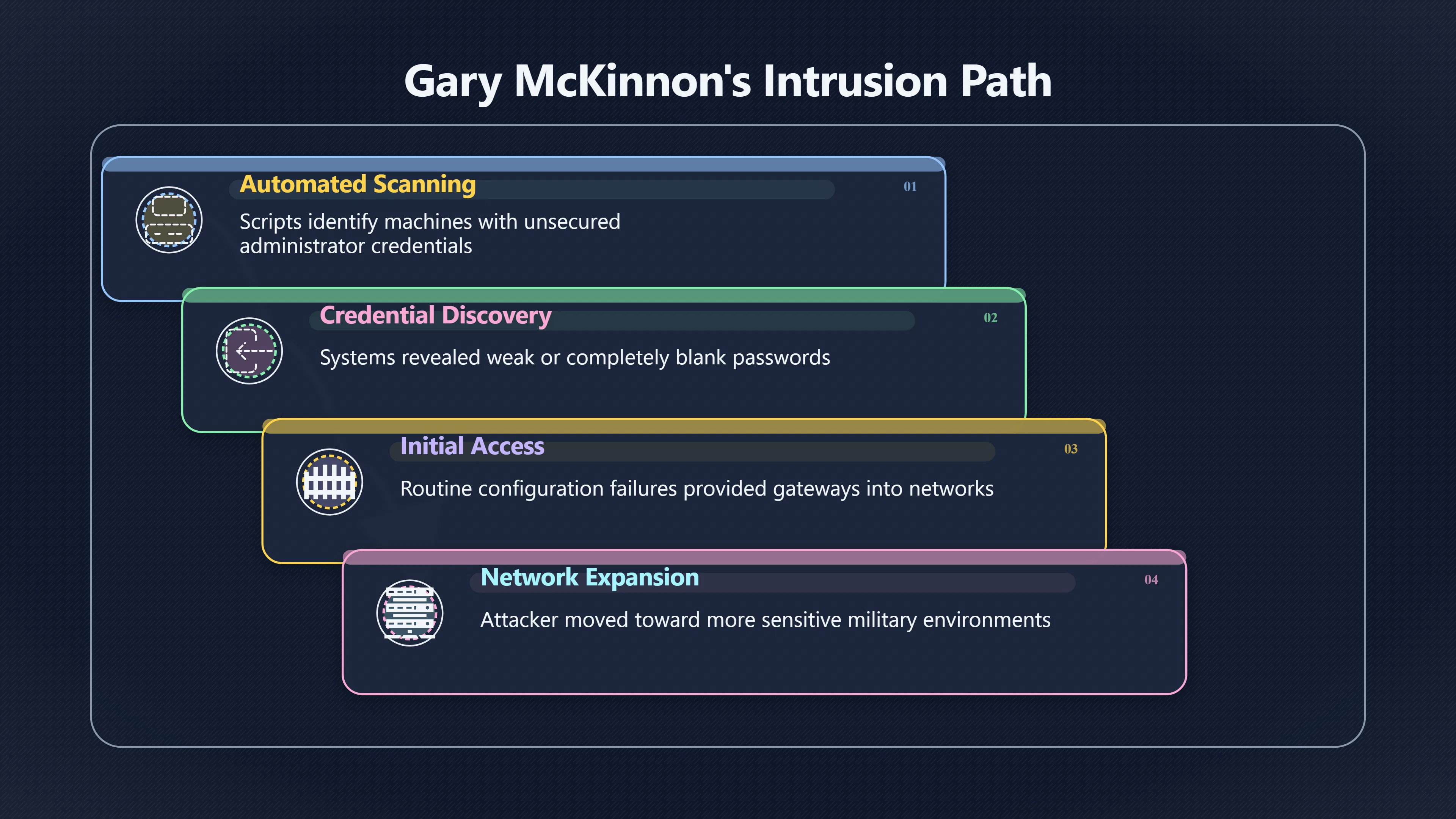
One of the most striking lessons from the Gary McKinnon case was not the sophistication of the intrusion but the simplicity of the access path. McKinnon, who said he was searching military and NASA systems for evidence related to UFOs and advanced technology, repeatedly described finding computers that were protected by weak, default, or even blank passwords. According to his public accounts, he used automated scanning methods to identify machines where administrator credentials had not been properly secured, turning routine configuration failures into gateways into sensitive networks.[theguardian.com]theguardian.comThe GuardianHacker's progress: how McKinnon pierced Pentagon security3 Apr 2007 — With such glaring errors leaving the backdoor wide open…
 Within the broader story of military network security weaknesses exposed by UFO-motivated hacking, blank passwords represent a particularly important failure mechanism. They demonstrate how an organisation can invest heavily in hardware, software, and perimeter defences while remaining vulnerable because basic access controls are not consistently enforced. The case became a cautionary example of how ordinary administrative lapses can create risks far greater than the technical complexity of the attack itself.[Cybereason]cybereason.comMalicious Life Podcast: The U.Svs. Gary McKinnonHe exploited known Windows vulnerabilities on computers without adequate password and firewall protections. The ease wit…
How Weak Credentials Opened the First Doors
The popular image of a military hacker often involves advanced exploits, secret vulnerabilities, or highly specialised technical knowledge. The McKinnon case challenged that assumption. Multiple accounts of the incident describe an attacker taking advantage of systems that lacked adequate password protection rather than defeating sophisticated security technologies. McKinnon himself stated in interviews that he searched for machines with blank administrator passwords, while later commentary from security researchers and journalists noted that default or unchanged passwords were among the weaknesses he encountered.[schneier.com]schneier.comgaruy mckinnonSchneier on SecurityGary McKinnon4 Aug 2008 — The interview I saw with McKinnon implied that he just hit systems with the default adminis…
This distinction matters because a blank password is not a software flaw in the conventional sense. The operating system may function exactly as designed. The vulnerability arises because an account that should require authentication effectively does not. In practical terms, a computer connected to a larger military network can become an entry point if administrators leave credentials unchanged after installation or fail to disable insecure default settings.[The Guardian]theguardian.comThe GuardianHacker's progress: how McKinnon pierced Pentagon security3 Apr 2007 — With such glaring errors leaving the backdoor wide open…
The ease of access was repeatedly emphasised in retrospective examinations of the case. A Cybereason analysis described McKinnon’s activities as relying largely on publicly available tools and on systems lacking adequate password and firewall protections, arguing that the ease of entry was itself a significant part of the story.[Cybereason]cybereason.comMalicious Life Podcast: The U.Svs. Gary McKinnonHe exploited known Windows vulnerabilities on computers without adequate password and firewall protections. The ease wit…
Why Basic Password Policy Failed at Scale
The most serious implication was not that one computer had a weak password. Large organisations, especially military organisations, operate thousands of systems administered by different teams, contractors, and local support staff. A password policy is only effective if it is consistently implemented and continuously verified.
The McKinnon case suggested a gap between policy and reality. Security procedures may have required strong passwords, but the existence of accessible systems with default or blank credentials indicated that enforcement was incomplete. As McKinnon told journalists years later, some of the “biggest loopholes” arose from users failing to change default passwords.[The Guardian]theguardian.comThe GuardianHacker's progress: how McKinnon pierced Pentagon security3 Apr 2007 — With such glaring errors leaving the backdoor wide open…
Several factors make this type of failure particularly dangerous at scale:
- Administrative convenience: Temporary accounts and test systems may be left with default credentials to simplify maintenance.
- Distributed responsibility: Different units may assume that another team is responsible for enforcing password standards.
- Legacy systems: Older computers often remain connected long after deployment and may not receive consistent security reviews.
- Trust assumptions: Internal systems are sometimes treated as inherently safer than internet-facing services, reducing scrutiny of authentication controls.
When these factors combine, a single weakly protected machine can become a bridge into a much larger environment. The security problem is therefore organisational as much as technical. A military network can possess advanced defensive capabilities while still being undermined by routine credential management failures.[Cybereason]cybereason.comMalicious Life Podcast: The U.Svs. Gary McKinnonHe exploited known Windows vulnerabilities on computers without adequate password and firewall protections. The ease wit…

Why Blank Passwords Were a Military Risk Rather Than a Mere IT Mistake
In an ordinary business environment, a blank password might expose local files or internal communications. In a military environment, the consequences can be broader because systems often connect to administrative, logistical, engineering, or operational networks.
The risk is not limited to what an intruder sees on the first compromised machine. Once authenticated access is obtained, the attacker may gain visibility into network structure, user accounts, shared resources, and trust relationships. Journalistic accounts of the McKinnon affair described him moving from less protected systems towards more sensitive environments by exploiting the trust granted to already authenticated users.[The Guardian]theguardian.comThe GuardianHacker's progress: how McKinnon pierced Pentagon security3 Apr 2007 — With such glaring errors leaving the backdoor wide open…
This illustrates a fundamental security principle: authentication is often the first and most important security boundary. If that boundary can be bypassed with a blank password, other protections may never have an opportunity to operate.
The case also highlighted a strategic concern. A curiosity-driven intruder looking for UFO information discovered weaknesses that a hostile intelligence service could potentially have exploited for espionage or disruption. The same credential failure that enabled one unauthorised visitor could have enabled many others with different motives.[Department of Justice]justice.govDepartment of JusticeLondon, England Hacker Indicted Under Computer Fraud…Gary McKinnon, of London, England, was indicted in Alexandri…
What the Case Teaches About Verifying Access Controls
Perhaps the most enduring lesson is that security controls cannot merely exist on paper. They must be tested against actual conditions.
Blank passwords are among the easiest weaknesses to detect through auditing. Organisations can identify them through automated scans, account reviews, configuration management systems, and regular compliance checks. The fact that systems described in the McKinnon case reportedly remained accessible suggests that verification processes were either absent, inconsistent, or ineffective.[The Guardian]theguardian.comThe GuardianHacker's progress: how McKinnon pierced Pentagon security3 Apr 2007 — With such glaring errors leaving the backdoor wide open…
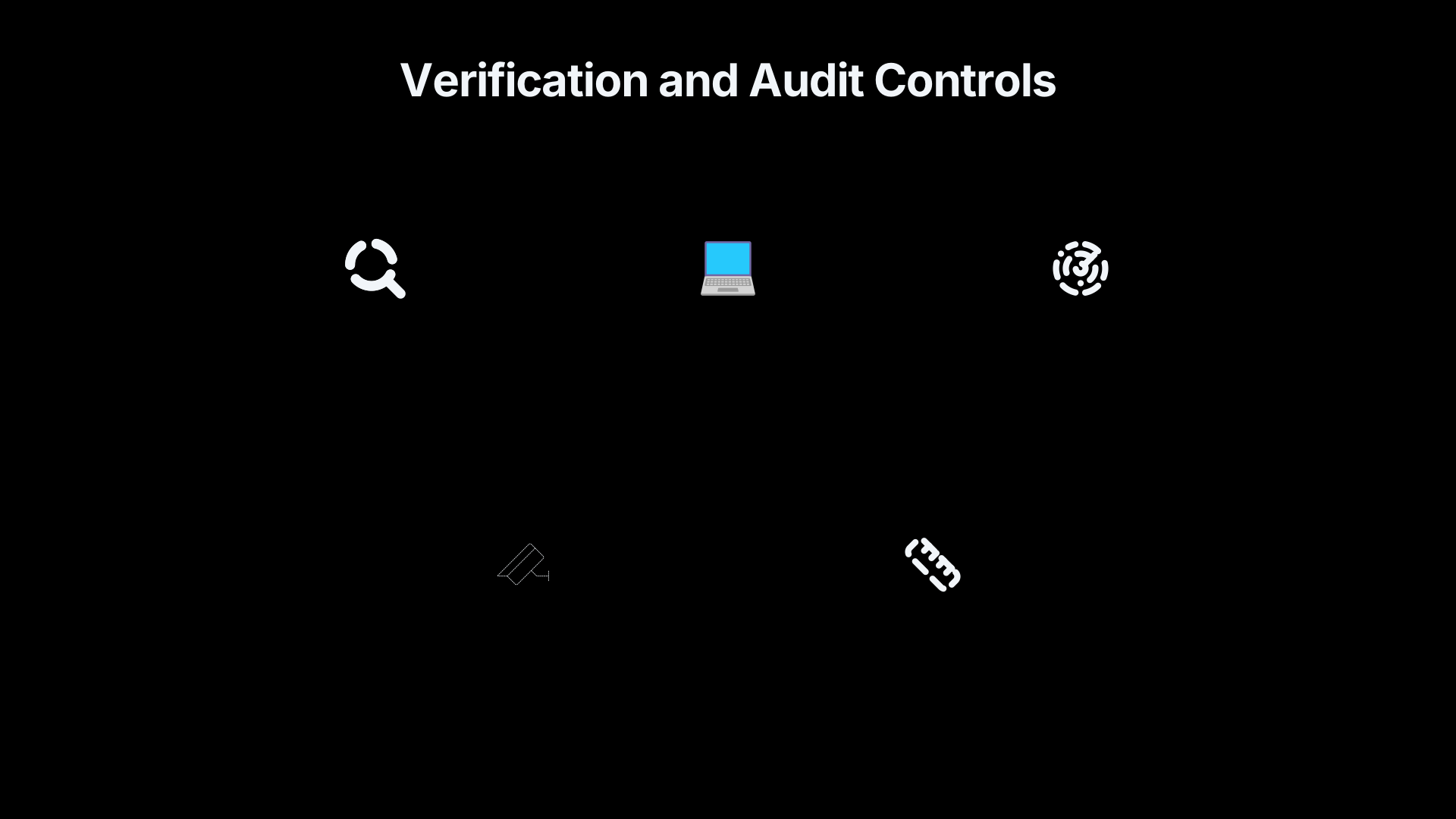
The broader lesson extends beyond passwords themselves. Security programmes often fail when organisations assume controls are functioning without independently confirming that they are. Effective access-control verification requires:
- Regular auditing of privileged accounts.
- Removal of default credentials before deployment.
- Automated detection of weak or blank passwords.
- Continuous monitoring rather than one-time compliance checks.
- Independent validation that policy requirements match operational reality.
Modern military and government cybersecurity programmes place far greater emphasis on these practices than was common in the early 2000s. Yet the underlying principle remains unchanged: the strength of a security system is often determined not by its most advanced technologies but by whether basic controls are consistently enforced. The McKinnon case became memorable precisely because it demonstrated how a seemingly mundane issue—blank passwords—could contribute to one of the most widely discussed military intrusion cases of its era.[cybereason.com]cybereason.comMalicious Life Podcast: The U.Svs. Gary McKinnonHe exploited known Windows vulnerabilities on computers without adequate password and firewall protections. The ease wit…
Amazon book picks
Further Reading
Books and field guides related to Why Blank Passwords Became a Military Risk. Use these as the next step if you want deeper reading beyond the article.
Cybersecurity and Cyberwar
Explains password policy, network security and risk management.
This Is How They Tell Me the World Ends
Shows how basic weaknesses can scale into serious threats.
eBay marketplace picks
Marketplace Samples
Example marketplace items related to this page. Use the search link to explore similar finds on eBay.

Endnotes
1.
Source: schneier.com
Title: garuy mckinnon
Link:https://www.schneier.com/blog/archives/2008/08/garuy_mckinnon.html
Source snippet
Schneier on SecurityGary McKinnon4 Aug 2008 — The interview I saw with McKinnon implied that he just hit systems with the default adminis...
2.
Source: cybereason.com
Title: Malicious Life Podcast: The U.S
Link:https://www.cybereason.com/blog/malicious-life-podcast-the-u.s-vs.-gary-mckinnon
Source snippet
vs. Gary McKinnonHe exploited known Windows vulnerabilities on computers without adequate password and firewall protections. The ease wit...
3.
Source: justice.gov
Link:https://www.justice.gov/archive/criminal/cybercrime/press-releases/2002/mckinnonIndict.htm
Source snippet
Department of JusticeLondon, England Hacker Indicted Under Computer Fraud...Gary McKinnon, of London, England, was indicted in Alexandri...
4.
Source: theguardian.com
Link:https://www.theguardian.com/uk/2007/apr/03/politics.usa
Source snippet
The GuardianHacker's progress: how McKinnon pierced Pentagon security3 Apr 2007 — With such glaring errors leaving the backdoor wide open...
5.
Source: Wikipedia
Title: Gary [Mc Kinnon]({{ ‘mc-kinnon/’ | relative_url }})
Link:https://it.wikipedia.org/wiki/Gary_McKinnon
6.
Source: Wikipedia
Title: Gary Mc Kinnon
Link:https://en.wikipedia.org/wiki/Gary_McKinnon
Source snippet
Gary McKinnonThe US government accused McKinnon of hacking into 97 United States military and NASA computers over a 13-month period be...
7.
Source: theguardian.com
Link:https://www.theguardian.com/theguardian/2005/jul/09/weekend7.weekend2
Source snippet
Game over | Gary McKinnon9 Jul 2005 — Gary McKinnon has been accused of committing the 'biggest military computer hack of all time', and...
Additional References
8.
Source: linkedin.com
Link:https://www.linkedin.com/posts/armourcyber_the-password-was-never-a-security-problem-activity-7458901102948683776-blwD
Source snippet
Armour Cybersecurity's PostToday is, a reminder that while passwords are still part of everyday business security, the conversation is qu...
9.
Source: cybersecurityventures.com
Link:https://cybersecurityventures.com/today/
Source snippet
CYBERCRIME WIRE: Latest Security And Privacy NewsOur daily feed provides you with the latest news and breaking stories on the cybereconom...
10.
Source: reddit.com
Link:https://www.reddit.com/r/hacking/comments/1etqs6b/how_gary_mckinnon_did_what_he_did/
11.
Source: ccdcoe.org
Link:https://ccdcoe.org/uploads/2018/10/2011_Proceedings_0-1.pdf
Source snippet
Strategic Cyber SecurityAs a consequence, all political and military conflicts now have a cyber dimension, the size and impact of which a...
12.
Source: facebook.com
Link:https://www.facebook.com/groups/617328327480084/posts/793396476539934/
Source snippet
03-01-26 JESSE MICHELS "Gary McKinnon hacked into...All accessed with a Perl script scanning for blank passwords... GARY McKiNNON: USA...
13.
Source: tesserent.com
Link:https://tesserent.com/insights/in-the-media/australians-warned-strengthen-passwords
Source snippet
Australians Warned to Strengthen PasswordsWith World Password Day looming on 5th May, Michael McKinnon, CIO of Thales Cyber Services ANZ...
14.
Source: reuters.com
Link:https://www.reuters.com/article/technology/exclusive-snowden-persuaded-other-nsa-workers-to-give-up-passwords-sources-idUSBRE9A7032/
Source snippet
Exclusive: Snowden persuaded other NSA workers to give...8 Nov 2013 — Reuters reported last month that the NSA failed to install the mos...
15.
Source: federalnewsnetwork.com
Link:https://federalnewsnetwork.com/cybersecurity/2026/05/some-of-the-biggest-cyber-risks-to-the-military-dont-start-inside-government-networks/
Source snippet
Some of the biggest cyber risks to the military don't start...20 May 2026 — Summary: By opening its Defense Industrial Base Cybersecurit...
Published: May 2026
16.
Source: youtube.com
Link:https://www.youtube.com/watch?v=2ttdlCa5ZCI
Source snippet
The Lone Hacker That Found NASA's [Secret Space Fleet]({{ 'space-fleet/' | relative_url }})...Gary McKinnon hacked into 97 U.S. military and government sites in... The Lone H...
17.
Source: futureintelligence.co.uk
Title: Gary Mc Kinnon was unlucky
Link:https://www.futureintelligence.co.uk/2012/10/18/gary-mckinnon-was-unlucky-hes-not-even-a-good-hacker/
Source snippet
He's not even a very good hackerOct 18, 2012 — “He was asking for passwords to US systems and ways to access them that were common knowle...
Topic Tree