Within Secrecy Stories
Why UAP evidence needs more than intrigue
NASA and AARO show why modern UAP claims are judged by data quality, provenance, and testability rather than intrigue.
On this page
- What official UAP reviews ask for
- Why anecdotes from hacked systems fall short
- A practical checklist for digital UFO claims
Page outline Jump by section
Introduction
Stories about UFO information found inside hacked government systems occupy a special place in secrecy narratives. The appeal is obvious: if a hacker such as Gary McKinnon gained access to restricted networks, perhaps they also discovered hidden truths. Modern official reviews of unidentified anomalous phenomena (UAP), however, evaluate claims by a very different standard. Rather than asking whether a story is intriguing or whether access was unauthorised, organisations such as NASA and the US Department of Defense’s All-domain Anomaly Resolution Office (AARO) focus on data quality, provenance, calibration, corroboration and reproducibility. The contrast is important because it highlights the difference between a claim about what someone remembers seeing and evidence that can be independently examined.[nasa.gov]science.nasa.govNASA ScienceIndependent Study Team ReportAt present, analysis of UAP data is hampered by poor sensor calibration, the lack of multiple me…
 Within the broader history of UFO hackers such as Gary McKinnon, this distinction explains why official UAP investigations do not treat anecdotal discoveries from hacked systems as equivalent to sensor-based evidence.
Why UAP evidence needs more than intrigue
What official UAP reviews ask for
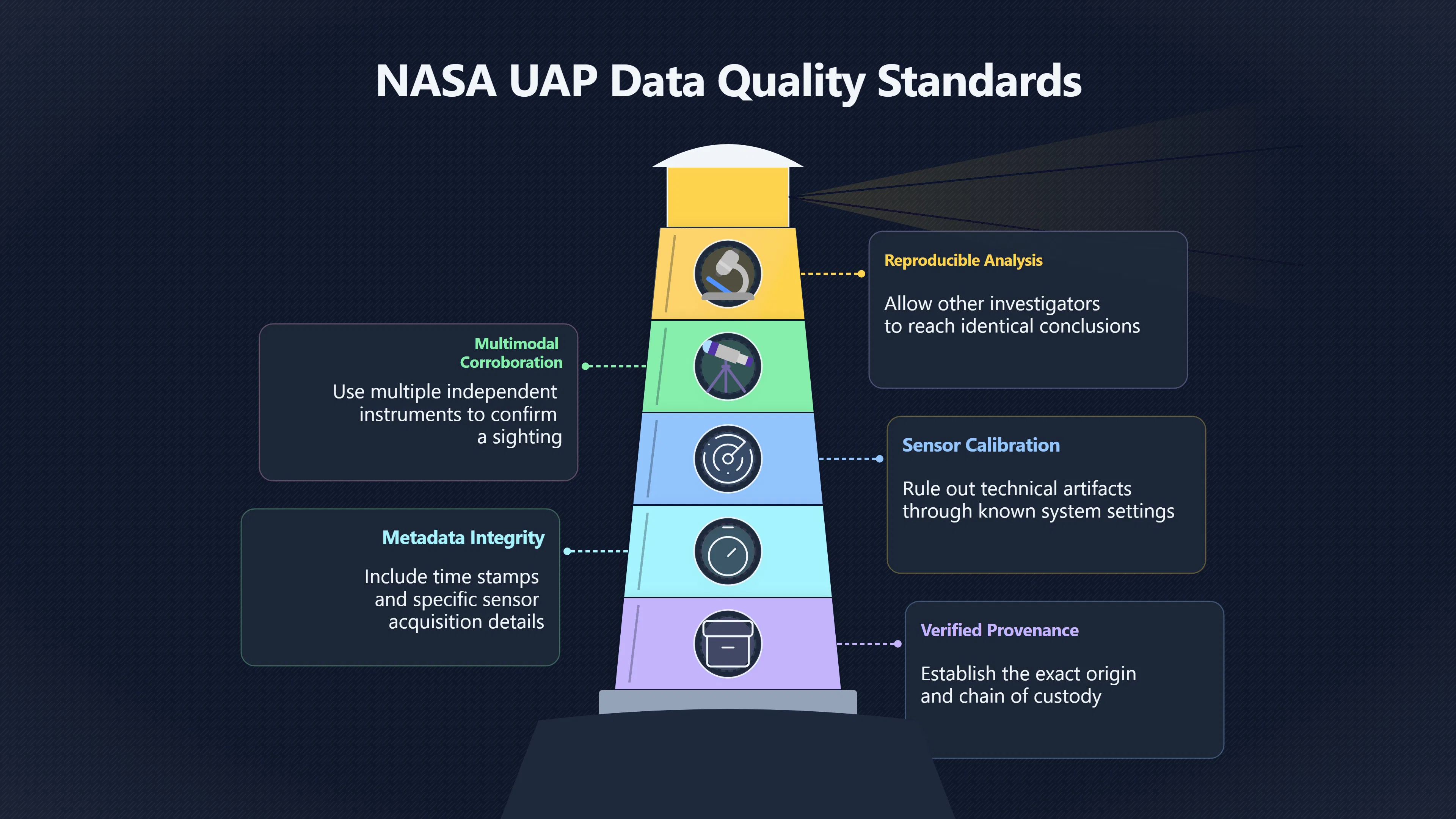
Recent UAP investigations have shifted the discussion away from rumours and towards measurable evidence. NASA’s independent UAP study concluded that analysis is often hindered by poor sensor calibration, missing metadata, insufficient measurements and a lack of contextual information. The report argued that progress depends on collecting better-quality observations rather than relying on isolated reports.[nasa.gov]science.nasa.govNASA ScienceIndependent Study Team ReportAt present, analysis of UAP data is hampered by poor sensor calibration, the lack of multiple me…
In practical terms, official reviewers look for several characteristics:
- Provenance: Where did the data come from, and can its origin be verified?
- Metadata: Are there timestamps, sensor specifications, location data and acquisition details?
- Multiple sources: Can more than one instrument or observer confirm the event?
- Calibration: Is the recording system understood well enough to rule out artefacts?
- Reproducibility: Can other investigators examine the same evidence and reach similar conclusions?
NASA’s study emphasised that apparent anomalies can disappear once metadata and calibration issues are examined carefully. Several cases initially perceived as unusual were later understood as sensor artefacts or ordinary objects when additional context became available.[Wikisource]en.wikisource.orgPage:UAP Independent Study TeamPage:UAP Independent Study Team - Final Report.pdf/1512 Nov 2023 — Indeed, several apparent UAP have been demonstrated to be se…
AARO’s public case releases follow a similar logic. Cases are catalogued with information about the reporting source, sensor type, duration of observation and analytical status. Some reports remain unresolved, but many have ultimately been identified as balloons, conventional objects or non-anomalous events after review of supporting data.[AARO]aaro.milUAP ImageryThe United States European Command submitted a report of an unidentified anomalous phenomenon to the All-domain Anomaly Re…
Why standards matter even when cases remain unresolved
An unresolved case is not automatically evidence of extraordinary technology. Official reviews repeatedly distinguish between “unidentified” and “alien”. AARO has stated that many unresolved reports simply lack sufficient information for a definitive conclusion and that better data could potentially resolve a large proportion of them.[Reuters]reuters.comMost sightings were identified as ordinary objects or phenomena. The All-domain Anomaly Resolution Office (AARO) released this conclusion…
This approach reflects a basic principle of evidence evaluation: uncertainty should be acknowledged rather than filled with speculation. The absence of an explanation is not itself proof of a hidden one.
Why anecdotes from hacked systems fall short
The McKinnon case illustrates the gap between unauthorised access and verifiable evidence. McKinnon consistently claimed that he entered NASA and military systems while searching for information about UFOs and suppressed technologies. He later described seeing a spreadsheet labelled “Non-Terrestrial Officers” and viewing imagery that he interpreted as showing a non-human craft.[wired.com]wired.comufo hacker tells what he foundWIRED'UFO Hacker' Tells What He Found21 Jun 2006 — One was titled "Non-Terrestrial Officers." It contained names and ranks of U.S. Air Fo…
The difficulty is that these claims largely exist as recollections rather than examinable evidence.
From the perspective of modern UAP standards, several problems immediately appear:
- No publicly authenticated copy of the spreadsheet has been produced.
- No complete image file, forensic acquisition record or chain of custody has been demonstrated.
- Independent investigators cannot inspect the alleged files.
- The context surrounding the material is unknown.
- Alternative explanations cannot be tested directly.
Even McKinnon acknowledged in interviews that some of what he found could potentially have had more ordinary explanations. The spreadsheet he described was never independently verified, and the reported image was not preserved in a form that could be subjected to technical analysis.[WIRED]wired.comufo hacker tells what he foundWIRED'UFO Hacker' Tells What He Found21 Jun 2006 — One was titled "Non-Terrestrial Officers." It contained names and ranks of U.S. Air Fo…
Under NASA’s or AARO’s framework, such claims fail not because they are impossible but because they cannot be independently evaluated. The standards are designed specifically to prevent conclusions from resting on inaccessible evidence, memory alone or undocumented interpretation.[NASA Science]science.nasa.govNASA ScienceIndependent Study Team ReportAt present, analysis of UAP data is hampered by poor sensor calibration, the lack of multiple me…
The hidden problem of missing context
A hacked system may contain incomplete files, drafts, simulations, test data, training material or internally generated labels whose meaning is unclear outside their original environment. Without metadata, documentation or corroboration, an observer can easily misunderstand what a file represents.
This is one reason official UAP studies place such emphasis on provenance. A filename, spreadsheet title or isolated image may sound significant, but investigators need to know who created it, why it was created, when it was created and whether it corresponds to an actual event. Without that context, interpretation becomes highly subjective.[NASA Science]science.nasa.govNASA ScienceIndependent Study Team ReportAt present, analysis of UAP data is hampered by poor sensor calibration, the lack of multiple me…
A practical checklist for digital UFO claims
When evaluating claims that UFO evidence was discovered inside a hacked, leaked or otherwise restricted system, the standards emerging from modern UAP reviews suggest a straightforward set of questions.
Can the evidence be examined?
If the claim depends entirely on someone’s recollection, there is little opportunity for independent verification. A preserved file, image, log or dataset is far stronger than a remembered observation.
Is the source traceable?
Investigators should be able to establish where the material originated and whether it is authentic. Anonymous files or undocumented screenshots provide weak provenance.
Is there supporting metadata?
Time, location, sensor information and creation history often matter as much as the primary file itself. Missing metadata sharply limits what can be concluded.[NASA Science]science.nasa.govNASA ScienceIndependent Study Team ReportAt present, analysis of UAP data is hampered by poor sensor calibration, the lack of multiple me…
Can other evidence confirm it?
The strongest UAP investigations increasingly rely on multiple sensors and independent measurements. Scientific projects studying UAPs have similarly argued for multimodal observations precisely because they help distinguish genuine anomalies from artefacts or misunderstandings.[arXiv]arxiv.orgThe Scientific Investigation of Unidentified Aerial Phenomena (UAP) Using Multimodal Ground-Based ObservatoriesMay 29, 2023…
Does the interpretation exceed the evidence?
A file labelled with unusual terminology may be intriguing, but labels are not explanations. Extraordinary interpretations require supporting evidence beyond the wording of a document or the memory of a witness.
The governance lesson from the UAP debate
The most significant shift in contemporary UAP investigation is not a new theory about extraterrestrial visitors. It is the move towards accountable standards for evidence. NASA’s study, AARO’s reviews and independent scientific initiatives all converge on a similar conclusion: reliable answers require transparent data, documented provenance and repeatable analysis.[nasa.gov]science.nasa.govNASA ScienceIndependent Study Team ReportAt present, analysis of UAP data is hampered by poor sensor calibration, the lack of multiple me…
Viewed through that lens, hacked UFO anecdotes and official UAP investigations are not competing sources of evidence operating under the same rules. They belong to different evidentiary categories. A hacker’s account may raise questions, inspire further inquiry or contribute to a secrecy narrative. Official UAP evaluation, by contrast, asks whether a claim can survive scrutiny when data, metadata, calibration and independent verification are brought to bear. That difference explains why modern UAP standards place far more weight on documented evidence than on even the most compelling stories of what someone says they saw inside a restricted system.
Amazon book picks
Further Reading
Books and field guides related to Why UAP evidence needs more than intrigue. Use these as the next step if you want deeper reading beyond the article.
eBay marketplace picks
Marketplace Samples
Example marketplace items related to this page. Use the search link to explore similar finds on eBay.




Endnotes
1.
Source: science.nasa.gov
Link:https://science.nasa.gov/wp-content/uploads/2023/09/uap-independent-study-team-final-report.pdf
Source snippet
NASA ScienceIndependent Study Team ReportAt present, analysis of UAP data is hampered by poor sensor calibration, the lack of multiple me...
2.
Source: nasa.gov
Title: update nasa shares uap independent study report names director
Link:https://www.nasa.gov/news-release/update-nasa-shares-uap-independent-study-report-names-director/
Source snippet
UPDATE: NASA Shares UAP Independent Study Report14 Sept 2023 — We found that NASA can help the whole-of-government UAP effort through...
3.
Source: wired.com
Link:https://www.wired.com/story/nasa-ufos-aliens-report-2023
Source snippet
The agency stressed the need to shift the conversation from sensationalism to science and eliminate the stigma associated with reporting...
4.
Source: en.wikisource.org
Title: Page:UAP Independent Study Team
Link:https://en.wikisource.org/wiki/Page%3AUAP_Independent_Study_Team_-_Final_Report.pdf/15
Source snippet
Page:UAP Independent Study Team - Final Report.pdf/1512 Nov 2023 — Indeed, several apparent UAP have been demonstrated to be se...
5.
Source: aaro.mil
Link:https://www.aaro.mil/UAP-Cases/Official-UAP-Imagery/
Source snippet
UAP ImageryThe United States European Command submitted a report of an unidentified anomalous phenomenon to the All-domain Anomaly Re...
6.
Source: reuters.com
Link:https://www.reuters.com/technology/space/pentagon-ufo-report-says-most-sightings-ordinary-objects-phenomena-2024-03-08/
Source snippet
Most sightings were identified as ordinary objects or phenomena. The All-domain Anomaly Resolution Office (AARO) released this conclusion...
7.
Source: wired.com
Title: ufo hacker tells what he found
Link:https://www.wired.com/2006/06/ufo-hacker-tells-what-he-found/
Source snippet
WIRED'UFO Hacker' Tells What He Found21 Jun 2006 — One was titled "Non-Terrestrial Officers." It contained names and ranks of U.S. Air Fo...
8.
Source: arxiv.org
Link:https://arxiv.org/abs/2305.18566
Source snippet
The Scientific Investigation of Unidentified Aerial Phenomena (UAP) Using Multimodal Ground-Based ObservatoriesMay 29, 2023...
Published: May 29, 2023
9.
Source: arxiv.org
Title: arXiv Galileo Project Observatory Class System Architecture
Link:https://arxiv.org/abs/2506.00125
10.
Source: theguardian.com
Link:https://www.theguardian.com/theguardian/2005/jul/09/weekend7.weekend2
Source snippet
The GuardianGame over | Gary McKinnon9 Jul 2005 — What Gary was hunting for, as he snooped around Nasa, and the Pentagon's network, was e...
Additional References
11.
Source: Wikipedia
Link:https://en.wikipedia.org/wiki/Gary_McKinnon
Source snippet
Gary McKinnonMcKinnon said that he was looking for evidence of free energy suppression and a cover-up of UFO activity and other technolog...
12.
Source: defensescoop.com
Title: hegseth ufo disclosure trump aaro uap caseload
Link:https://defensescoop.com/2026/02/25/hegseth-ufo-disclosure-trump-aaro-uap-caseload/
Source snippet
AARO has been examining over 2,000 UAP cases.” “AARO has approximately 1,000 reports that lack sufficient data for analysis and are retai...
Topic Tree