Within No Files
The Clues Around the Missing File
Visible filenames, folder paths and timestamps could help separate a real NASA file trail from a copied image, joke or scenario.
On this page
- Why directory context matters
- What filenames and timestamps can reveal
- How ordinary folders can change meaning
Page outline Jump by section
Introduction
In the Gary McKinnon UFO story, the missing screenshot is only part of the problem. Even if an image or spreadsheet had been saved, investigators would still need to know where it came from. Filenames, folder locations, directory structures and timestamps can provide crucial clues about whether a file was part of a genuine NASA workflow, a temporary test file, a training exercise, a copied image or even a joke placed on a system. McKinnon has described seeing folders containing different versions of images and a spreadsheet he interpreted as significant, but no publicly available file trail exists that allows those claims to be independently tested.[Wikipedia]WikipediaGary Mc KinnonGary Mc Kinnon
 For UFO-related claims, file context often matters almost as much as the file itself. A document without its surrounding directory information is difficult to authenticate. A document with a clear path, naming convention and timestamp history can sometimes be traced back to specific systems, projects or users.
The Clues Around the Missing File
Why directory context matters
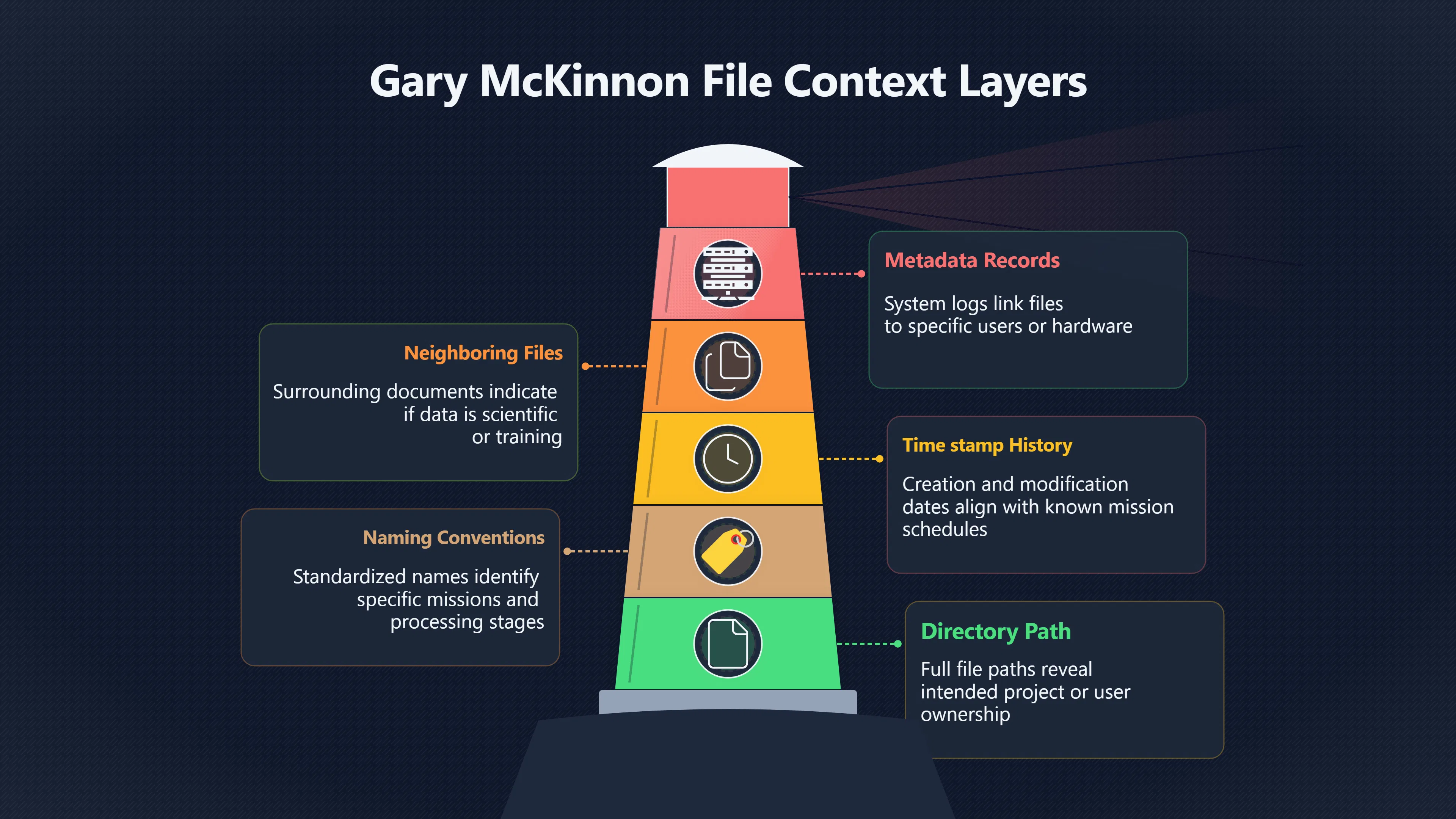
A file rarely exists in isolation on a large government or research network. Organisations such as NASA typically organise information through structured directories, project folders, archives and version-controlled workflows. The location of a file can reveal what it was intended to be.
For example, a supposed UFO image found in a folder associated with image processing might mean something very different from the same image appearing in a training directory, a graphics-design folder or a personal user account.
Directory context can help answer questions such as:
- Was the file stored alongside related scientific material?
- Did neighbouring files follow the same naming pattern?
- Was the folder part of an operational project or a temporary workspace?
- Did the directory contain documentation explaining the files?
- Were there earlier or later versions of the same material?
In McKinnon’s account, he described seeing what he believed were processed and unprocessed image folders. If those folders had been documented, investigators could have examined whether they matched known NASA image-management practices or whether they were being interpreted incorrectly.[Wikipedia]WikipediaGary Mc KinnonGary Mc Kinnon
What filenames and timestamps can reveal
Filenames often contain more information than casual observers realise.
A government image archive may use standard naming conventions that identify a mission, camera, processing stage, operator or date. Likewise, spreadsheets often include project codes, department identifiers or version numbers.
Consider how different filenames would affect credibility:
- IMG0001.BMP provides little context.
- STS107_RAW_2003_01_16.TIF suggests a specific mission and date.
- UFO_SECRET_IMAGE.JPG may appear dramatic but could actually reduce credibility because it does not resemble normal professional file naming.
Timestamps are equally important. Creation dates, modification dates and access dates can help establish whether a file fits the timeline being claimed. If a supposedly historic discovery was actually created shortly before it was viewed, that would raise obvious questions.
Investigators also compare timestamps against known events. If an image is said to come from a particular satellite pass or mission, the file’s dates can be checked against mission schedules, image-processing logs and archive records.
Without access to the original files, these tests cannot be performed on the material McKinnon described. The public is left with recollections rather than artefacts.[Wikipedia]WikipediaGary Mc KinnonGary Mc Kinnon

How Ordinary Folders Can Change Meaning
One of the easiest mistakes in digital investigations is assuming that a striking filename automatically proves a striking claim.
Context can completely alter interpretation.
A spreadsheet titled “Non-Terrestrial Officers” might sound extraordinary when quoted alone. Yet investigators would immediately want to know:
- Which folder contained it?
- What other spreadsheets were stored nearby?
- Did surrounding files indicate a simulation, game, research project or training scenario?
- Who created it?
- Was it linked to any known programme?
Notably, McKinnon himself acknowledged the possibility that the spreadsheet he saw could have been part of a game or another non-literal scenario.[Wikipedia]WikipediaGary Mc KinnonGary Mc Kinnon
The surrounding directory could have helped answer that question. A file located inside a military exercise folder carries a different meaning from the same file appearing inside an administrative personnel database.
This is why digital investigators rarely evaluate filenames in isolation. The folder tree, neighbouring files and metadata often determine whether an apparently remarkable title remains remarkable after scrutiny.
Reconstructing a Real File Trail
When investigators attempt to authenticate a digital discovery, they typically look for a chain of evidence rather than a single item.
Useful indicators include:
- The full file path showing where the item was stored.
- Directory listings showing related files.
- Consistent naming conventions across a project.
- Metadata records linking the file to users or systems.
- Timestamp patterns that fit documented workflows.
- Corroborating files that reference the same project or subject.
A genuine NASA image archive, for example, would normally be expected to contain many related files rather than one isolated image. Multiple files sharing naming conventions, dates and processing histories are generally more persuasive than a single detached screenshot.
The absence of this wider context is one reason the UFO portion of the McKinnon story remains difficult to verify. While the unauthorised access itself is extensively documented in legal records, the alleged UFO-related material lacks the file trail that would allow independent examination.[Department of Justice]justice.govDepartment of JusticeLondon, England Hacker Indicted Under Computer Fraud…Gary McKinnon, of London, England, was indicted in Alexandri…

Why File Context Often Matters More Than the Image
A striking image can attract attention, but investigators usually place greater weight on the evidence surrounding it. Images can be copied, renamed, edited or misunderstood. Directory structures, file histories and timestamp patterns are often harder to fabricate consistently.
For that reason, the most valuable missing evidence in many UFO-related digital claims is not necessarily the image itself. It is the ecosystem around the image: the folder path, neighbouring files, naming conventions, metadata and chronology.
Had those elements been preserved in the McKinnon case, they could have helped distinguish between a genuine NASA data trail, an ordinary aerospace image, a simulation, a misplaced file or a misunderstanding of what was being viewed. Without them, the claim remains largely beyond independent verification, because the context that would allow rigorous testing is absent.[Wikipedia]WikipediaGary Mc KinnonGary Mc Kinnon
Amazon book picks
Further Reading
Books and field guides related to The Clues Around the Missing File. Use these as the next step if you want deeper reading beyond the article.
The Demon-Haunted World
Rating: 4.5/5 from 43 Google Books ratings
Reinforces evidence-based assessment of extraordinary claims.
Guide to Computer Forensics and Investigations
Covers file paths, timestamps, provenance and evidence handling.
File System Forensic Analysis
Explains directory structures and metadata interpretation.
eBay marketplace picks
Marketplace Samples
Live-tested eBay searches with available results related to this page.



Endnotes
1.
Source: Wikipedia
Title: Gary Mc Kinnon
Link:https://en.wikipedia.org/wiki/Gary_McKinnon
2.
Source: justice.gov
Link:https://www.justice.gov/archive/criminal/cybercrime/press-releases/2002/mckinnonIndict.htm
Source snippet
Department of JusticeLondon, England Hacker Indicted Under Computer Fraud...Gary McKinnon, of London, England, was indicted in Alexandri...
3.
Source: justice.gov
Title: Department of Justice British National Charged with Hacking Into N.J
Link:https://www.justice.gov/archive/criminal/cybercrime/press-releases/2002/mckinnonIndict2.htm
Source snippet
seven-count Virginia [Indictment]({{ 'indictment/' | relative_url }}) charges McKinnon for intrusions into 92 computer systems belonging to the U.S. Army, Navy, A...
4.
Source: justice.gov
Title: edva mckinnon indictment
Link:https://www.justice.gov/archive/usao/nj/Press/files/pdffiles/Older/edva_mckinnon_indictment.pdf
Source snippet
Indictment**. GARY MCKINNON. Defendant. } Criminal No. } 18 U.S.C. § 1030. } Fraud and Related Activity in. Connection with Computers. (...
5.
Source: criminal.laws.com
Title: gary mckinnon
Link:https://criminal.laws.com/gary-mckinnon
Source snippet
McKinnon - LAWS.com - Criminal22 Dec 2019 — As the result of an American investigation, a grand jury in Virginia indicted Gary McKinnon i...
Additional References
6.
Source: reddit.com
Link:https://www.reddit.com/r/hacking/comments/1etqs6b/how_gary_mckinnon_did_what_he_did/
7.
Source: slideshare.net
Link:https://www.slideshare.net/slideshow/report-on-hacking/70755651
Source snippet
Report on Hacking | PDF... 97 computers belonging to the U.S. Armed Forces and NASA. McKinnon claimed that he was only searching for info...
8.
Source: scribd.com
Link:https://www.scribd.com/document/83849328/Project-Camelot-Gary-McKinnon-Transcript
Source snippet
McKinnon claims he was looking for information...Read more...
9.
Source: theguardian.com
Title: gary [mckinnon extradition]({{ ‘reform/’ | relative_url }}) timeline
Link:https://www.theguardian.com/world/2009/nov/26/gary-mckinnon-extradition-timeline
Source snippet
Timeline: Gary McKinnon's fight against extradition to the US26 Nov 2009 — Between 1 February 2001 and 19 March 2002, Gary McKinnon alleg...
Published: February 2001
10.
Source: youtube.com
Title: The Lone Hacker That Found NASA’s Secret Space Fleet [Gary Mc Kinnon Interview]
Link:https://www.youtube.com/watch?v=2ttdlCa5ZCI
Source snippet
Ancient Aliens: Hacking NASA Secrets (Season 12, Episode 9) | History...
11.
Source: youtube.com
Title: The Interview They Tried to Erase From the Internet
Link:https://www.youtube.com/watch?v=WvILY-h-6_Y
Source snippet
The Lone Hacker That Found NASA's Secret Space Fleet [Gary McKinnon Interview]...
12.
Source: computer.howstuffworks.com
Link:https://computer.howstuffworks.com/cyberwar.htm
Source snippet
coming?One famous case is the United States' indictment of hacker Gary McKinnon. Since 2002, McKinnon fought extradition charges to the U...
13.
Source: youtube.com
Title: Ancient Aliens: Hacking NASA Secrets (Season 12, Episode 9) | History
Link:https://www.youtube.com/watch?v=20rWFDfh68Y
Source snippet
The Man Who Hacked the U.S. Government...
14.
Source: youtube.com
Title: The Man Who Hacked the U.S. Government
Link:https://www.youtube.com/watch?v=ND0zQX1rGdg
Source snippet
Richplanet TV - Gary McKinnon - Parts 1 TO 4...
15.
Source: youtube.com
Title: Richplanet TV
Link:https://www.youtube.com/watch?v=N-AmbbI4jgQ
Topic Tree