Within UFO Hackers
Does UFO Belief Change Cybercrime Risk?
The McKinnon case shows why a sincere UFO motive does not make unauthorized access harmless.
On this page
- Curiosity as motive
- Damage and disruption claims
- How law treats intent and harm
Page outline Jump by section
Introduction
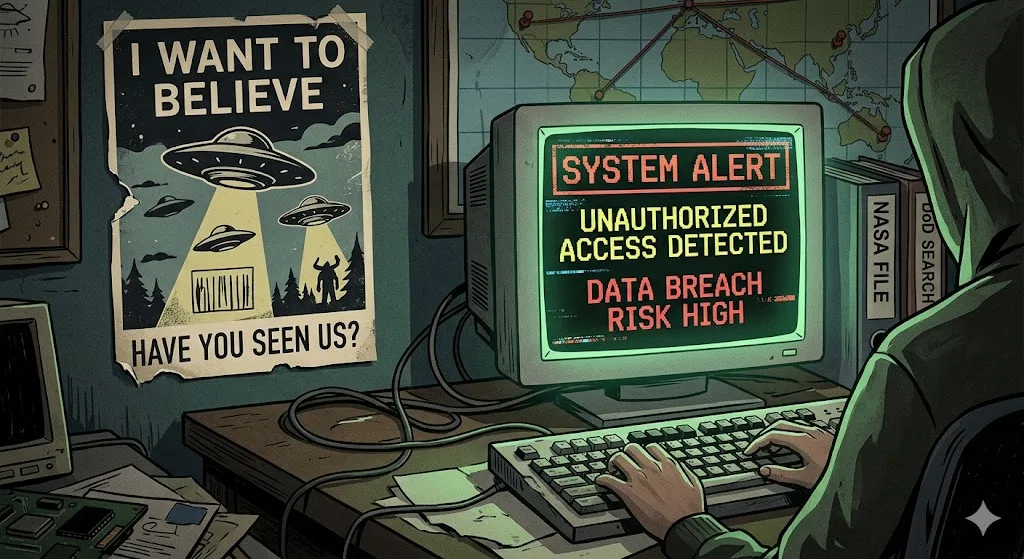
Gary McKinnon’s case is often told as a UFO story: a British systems administrator who said he entered US military and NASA systems because he believed hidden evidence of UFOs, anti-gravity technology and “free energy” might be there. But the cybercrime lesson is sharper than the folklore. A sincere or obsessive UFO motive may explain why someone crossed a line, yet it does not make unauthorised access harmless, especially when the target is defence, space or government infrastructure.
The McKinnon case shows the split between motive and consequence. McKinnon described himself as a seeker of suppressed information, not a thief or spy; US prosecutors alleged unauthorised access and damage across dozens of military and NASA computers, with serious operational and financial consequences. The useful question is therefore not whether he really believed in UFO secrecy. It is whether belief changes the risk created by breaking into systems that other people depend on. In law, security practice and public-interest ethics, the answer is mostly no: motive can matter to culpability and sentencing, but it does not erase intrusion, disruption, repair costs, or the fear caused by an unknown actor inside sensitive networks.[Department of Justice]justice.govDepartment of JusticeLondon, England Hacker Indicted Under Computer Fraud…One count charges McKinnon with accessing and damaging witho…
Curiosity Is a Motive, Not a Permission Slip
McKinnon’s own account matters because it helps explain why the case became culturally distinctive. In interviews, he said he was searching for proof that governments were concealing UFO and anti-gravity information, including claims about NASA imagery and a spreadsheet he described as listing “Non-Terrestrial Officers”. Those claims remain unverified, but they explain why his story travelled through UFO communities rather than being remembered only as an early-2000s hacking prosecution.[WIRED]wired.comufo hacker tells what he foundWIRED'UFO Hacker' Tells What He Found21 Jun 2006 — The search for proof of the existence of UFOs landed Gary McKinnon in a world of troub…
That motive is different from many familiar cybercrime motives: money, identity theft, political protest, espionage or ransomware. It is closer to a belief-driven intrusion, where the hacker sees unauthorised access as a way to uncover hidden truth. The ethical danger is that this framing can make the act feel investigative rather than invasive. If someone believes a system contains evidence that should be public, the temptation is to treat the target as a locked archive rather than as a live operational environment.
But computer systems are not neutral filing cabinets. Logging into a machine without permission can expose credentials, alter logs, trigger investigations, consume incident-response resources and create uncertainty about what was viewed, copied, changed or left behind. That uncertainty is itself a consequence. A defence organisation that discovers an unknown user in its systems cannot safely assume the intruder was merely curious, because the same access path could be used for sabotage, espionage or preparation for later attacks.
The McKinnon case is therefore a useful corrective to a romantic “truth seeker” narrative. Even if a UFO motive is sincere, the target still experiences the intrusion as a security breach. The people responsible for the system must treat it as a hostile event until they can prove otherwise, and in sensitive environments that proof may be expensive, slow and operationally disruptive.
Why the Claimed Damage Became the Central Dispute
The most important factual divide in the case was not simply “UFO believer versus government secrecy”. It was “harmless snooping versus serious damage”. The US Department of Justice said McKinnon was indicted in 2002 on seven counts of computer fraud and related activity. The indictment alleged that between March 2001 and March 2002 he accessed and damaged 92 computers belonging to the US Army, Navy, Air Force, Department of Defense and NASA, along with six computers belonging to private businesses.[Department of Justice]justice.govDepartment of JusticeLondon, England Hacker Indicted Under Computer Fraud…One count charges McKinnon with accessing and damaging witho…
Contemporary reporting repeatedly reflected the same divide. McKinnon admitted hacking into US networks but denied causing the scale of harm alleged against him. US authorities described hundreds of thousands of dollars in damage and disruption; McKinnon and his supporters portrayed him as a “bumbling” or misguided computer enthusiast whose actions exposed weak security rather than causing major operational harm.[Pinsent Masons]pinsentmasons.comPinsent MasonsJudge approves extradition of 'Pentagon hacker'May 10, 2006 — 10 May 2006 — McKinnon has admitted hacking the US networks…
That dispute matters because cyber harm is often less visible than physical damage. A person may not smash a server or steal cash, yet still create costs through:
- Forensic investigation: determining what was accessed, copied, changed or deleted.
- System rebuilding: wiping and restoring machines that may no longer be trusted.
- Credential resets: replacing passwords and administrative access after compromise.
- Operational caution: taking systems offline or limiting use while the breach is assessed.
- Security hardening: closing exposed services, patching weaknesses and reviewing logs.
- Institutional alarm: treating unknown access to military or space systems as a possible national-security incident.
This is where “I only looked” becomes legally and practically weak. In ordinary life, trespass into a sensitive facility would still matter even if the intruder claimed to be searching for evidence rather than stealing equipment. In cyber systems, the same principle applies with an added problem: after unauthorised entry, the owner may not immediately know whether the intruder only looked.
McKinnon’s supporters often emphasised the apparent simplicity of his methods and the weakness of the systems he accessed. That point may be relevant to institutional embarrassment, but it is not a defence to the intrusion itself. A poorly locked door does not grant public permission to enter, and an insecure computer does not turn unauthorised access into authorised research.
The UFO Motive Can Distort Public Sympathy
The UFO element changed how the case was received. A conventional cybercrime case about defence networks might sound remote and technical. A case involving a man searching for hidden UFO evidence sounds human, eccentric and almost cinematic. That makes it easier for supporters to focus on intention rather than consequence.
There are good reasons to avoid caricaturing McKinnon. The extradition battle later involved serious mental-health issues, including Asperger’s syndrome and depression, and the UK Home Secretary ultimately blocked extradition in 2012 on human-rights grounds because of the assessed risk that he might end his life if sent to the United States. Theresa May’s statement did not say the alleged offences were trivial; it explicitly described him as accused of serious crimes while concluding that extradition would be incompatible with his human rights.[GOV.UK]GOV.UKGary Mc Kinnon extradition case: Home Secretary's statementGary Mc Kinnon extradition case: Home Secretary's statement
That distinction is crucial. Humanitarian concern about punishment, extradition or mental health is not the same as saying the underlying conduct was harmless. A fair assessment can hold both ideas at once: McKinnon may have been vulnerable and sincerely motivated, while the systems he accessed were still entitled to protection and the authorities still had reason to treat the intrusion seriously.
The UFO motive also creates a credibility trap. Because the alleged purpose was to find hidden truth, any official denial or prosecution can be folded back into the believer’s narrative as evidence of suppression. That makes the case unusually resistant to closure. Yet for cyber risk, the evidential burden remains ordinary: claims about what he found need verification, while claims about unauthorised access can be evaluated through logs, admissions, indictments and court proceedings.
How Law Separates Intent From Harm
UK cybercrime law helps explain why motive does not decide everything. The Computer Misuse Act 1990 criminalises unauthorised access to computer material under section 1. The core issue is not whether the person had a romantic, political or financial motive, but whether they intentionally sought access, whether that access was unauthorised, and whether they knew it was unauthorised.[Legislation.gov.uk]legislation.gov.ukOpen source on legislation.gov.uk.
Intent still matters, but it matters in a structured way. A person who accidentally opens the wrong file is different from someone who deliberately probes computers for weak credentials. A person who accesses a system intending to steal money is different from someone who accesses it out of curiosity. A person who deliberately impairs a computer system faces different legal questions from someone who merely views data. But none of those distinctions turns unauthorised access into authorised access.
The Crown Prosecution Service’s guidance separates cyber-dependent offences, such as unauthorised access or impairment of computer systems, from broader cyber-enabled crime. It also recognises more serious offences where unauthorised acts impair systems or create serious risks, including risks to national security or critical infrastructure.[Crown Prosecution Service]cps.gov.ukCrown Prosecution Service CybercrimeCrown Prosecution Service Cybercrime
For McKinnon, this helps clarify the central tension. His stated UFO motive could be relevant to whether he was a spy, a fraudster, a saboteur or a vulnerable obsessive. It could also be relevant to charging choices, public-interest assessment, mitigation and extradition fairness. But it would not by itself answer whether he knowingly entered systems without permission, nor whether his actions caused disruption or damage.
Why Sensitive Targets Raise the Stakes
A UFO motive might sound less threatening when imagined as one person searching a database. The risk changes when the systems belong to military, defence or space agencies. McKinnon was accused of gaining access to computers used by the US Army, Navy, Air Force, Department of Defense and NASA. The House of Lords judgment in his extradition litigation described the US request as alleging unauthorised access to 97 US government computers from his home in London.[UK Parliament]publications.parliament.ukmckinn 1mckinn 1
Sensitive targets create three special problems.
First, the defenders cannot know the intruder’s true purpose at the moment of discovery. A person who says he is seeking UFO files may look, from inside the network, like a reconnaissance actor mapping systems for later abuse.
Second, the compromised systems may be connected to wider operational trust. Even if one machine seems unimportant, credentials, shared services or network relationships can make it a stepping stone.
Third, the timing and context matter. McKinnon’s alleged activity took place in 2001 and 2002, a period when US defence institutions were especially alert to threats after the 11 September attacks. In that environment, unexplained access to military systems would naturally be treated as more than idle curiosity.
This does not prove every alleged damage figure, nor does it resolve every dispute about prosecution strategy. It does explain why the “UFO seeker” frame could never be the whole story. From the defender’s side, the practical question was not “Does this person believe in UFOs?” but “What systems were entered, what changed, what was exposed, and what must now be trusted or rebuilt?”
The McKinnon Case Shows the Limits of “Public Interest” Hacking
Some readers may ask whether a search for hidden information could ever be justified if the hacker believed the public had a right to know. That question is important, but McKinnon’s case also shows why “public interest” cannot simply be self-certified by the intruder.
Responsible disclosure and public-interest journalism normally depend on evidence handling, minimisation, legal advice, source protection, editorial scrutiny and an effort to avoid unnecessary harm. Unauthorised roaming through government systems lacks those safeguards. It may discover something important, but it may also expose unrelated data, damage systems, compromise investigations or create a security incident whose costs fall on people who had no role in the alleged secrecy.
The UFO context makes this especially unstable. McKinnon’s claimed discoveries have not been publicly authenticated through released files, independent chain of custody or corroborating documentation. The result is an asymmetry: the intrusion and legal proceedings are documented, while the UFO payoff remains an unverified personal account. That makes the risk concrete and the claimed public benefit speculative.[WIRED]wired.comufo hacker tells what he foundWIRED'UFO Hacker' Tells What He Found21 Jun 2006 — The search for proof of the existence of UFOs landed Gary McKinnon in a world of troub…
This is the strongest critique of the romantic version of the story. If a hacker breaks into sensitive systems and produces verifiable evidence of grave wrongdoing, public debate may still weigh illegality against disclosure value. If the hacker breaks in and produces no independently checkable evidence, the public is left mainly with the harm, the legal fight and a legend.
What the Extradition Outcome Did—and Did Not—Decide
The eventual UK decision to block extradition did not vindicate the UFO motive or dismiss the seriousness of unauthorised access. In October 2012, Theresa May withdrew the extradition order because extradition would create a high suicide risk and would be incompatible with McKinnon’s human rights. She then left it to the Director of Public Prosecutions to decide whether he should face proceedings in the UK.[GOV.UK]GOV.UKGary Mc Kinnon extradition case: Home Secretary's statementGary Mc Kinnon extradition case: Home Secretary's statement
In December 2012, UK authorities announced that McKinnon would not face charges in Britain. Reporting at the time said police and prosecutors considered the chances of conviction poor, with difficulties connected to evidence, witnesses and the fact that the alleged harm and much of the evidence were in the United States.[The Guardian]theguardian.comgary mckinnon no uk chargesgary mckinnon no uk charges
This outcome is sometimes misunderstood. It did not mean that UFO curiosity made the hacking lawful. It did not mean the alleged damage was proven false. It did not mean McKinnon’s claims about UFO material were verified. It meant that extradition was blocked on human-rights grounds and that a UK prosecution was not pursued.
That distinction matters for anyone using the case as a moral precedent. The legal ending was about extradition, health, jurisdiction, evidence and prosecutorial judgment. It was not a ruling that belief-driven hacking is acceptable when the belief concerns UFO secrecy.

The Practical Lesson for UFO Researchers and Cybersecurity Readers
The McKinnon case is still relevant because it sits at the intersection of conspiracy belief, state secrecy, weak security and criminal law. It shows how a person can see himself as a researcher while institutions see an intruder; how a dramatic motive can attract sympathy while operational consequences remain real; and how a case can become a cultural symbol without proving the thing that made it famous.
For UFO researchers, the lesson is that evidence obtained through unauthorised access is legally dangerous, ethically compromised and often evidentially weak. Without preserved files, metadata, provenance and independent verification, sensational claims become stories rather than proof. The more extraordinary the alleged discovery, the more important lawful collection and authentication become.
For cybersecurity readers, the lesson is that motive should not be ignored, but it should not dominate risk assessment. A curious intruder may still create expensive incident response. A non-commercial intruder may still expose credentials. A believer in hidden truth may still disrupt systems. A person who does not intend national-security harm may still cause national-security concern.
The McKinnon case is therefore best understood as a warning against collapsing three separate questions into one. Why did he do it? What did he actually access or change? What consequences followed for the systems and people involved? UFO belief may help answer the first question. It does not settle the second or excuse the third.
Amazon book picks
Further Reading
Books and field guides related to Does UFO Belief Change Cybercrime Risk?. Use these as the next step if you want deeper reading beyond the article.
eBay marketplace picks
Marketplace Samples
Live-tested eBay searches with available results related to this page.


Endnotes
1.
Source: justice.gov
Link:https://www.justice.gov/archive/criminal/cybercrime/press-releases/2002/mckinnonIndict.htm
Source snippet
Department of JusticeLondon, England Hacker Indicted Under Computer Fraud...One count charges McKinnon with accessing and damaging witho...
2.
Source: wired.com
Title: ufo hacker tells what he found
Link:https://www.wired.com/2006/06/ufo-hacker-tells-what-he-found/
Source snippet
WIRED'UFO Hacker' Tells What He Found21 Jun 2006 — The search for proof of the existence of UFOs landed Gary McKinnon in a world of troub...
3.
Source: GOV.UK
Title: Gary [Mc Kinnon]({{ ‘mc-kinnon/’ | relative_url }}) extradition case: Home Secretary’s statement
Link:https://www.gov.uk/government/speeches/gary-mckinnon-extradition-case-home-secretarys-statement
4.
Source: legislation.gov.uk
Link:https://www.legislation.gov.uk/ukpga/1990/18/contents
5.
Source: cps.gov.uk
Title: computer misuse act
Link:https://www.cps.gov.uk/prosecution-guidance/computer-misuse-act
6.
Source: cps.gov.uk
Title: Crown Prosecution Service Cybercrime
Link:https://www.cps.gov.uk/prosecution-guidance/cybercrime-prosecution-guidance
7.
Source: publications.parliament.uk
Title: mckinn 1
Link:https://publications.parliament.uk/pa/ld200708/ldjudgmt/jd080730/mckinn-1.htm
8.
Source: wired.com
Title: terrorist or ufo truth seeker
Link:https://www.wired.com/2006/04/terrorist-or-ufo-truth-seeker/
9.
Source: justice.gov
Link:https://www.justice.gov/archive/usao/nj/Press/files/pdffiles/Older/edva_mckinnon_indictment.pdf
10.
Source: justice.gov
Link:https://www.justice.gov/archive/criminal/cybercrime/press-releases/2002/mckinnonIndict2.htm
11.
Source: assets.publishing.service.gov.uk
Title: public views 4
Link:https://assets.publishing.service.gov.uk/media/5a7aaeb5e5274a34770e661b/public-views-4.pdf
12.
Source: assets.publishing.service.gov.uk
Title: 2014 06 03 signed IA CMA EU Directive
Link:https://assets.publishing.service.gov.uk/media/5a7e26f6e5274a2e8ab462ca/2014-06-03_signed_IA_CMA_EU_Directive.pdf
13.
Source: assets.publishing.service.gov.uk
Title: public consultation 7
Link:https://assets.publishing.service.gov.uk/media/5a7ad76ce5274a34770e77c2/public-consultation-7.pdf
14.
Source: hansard.parliament.uk
Title: uk Gary Mc Kinnon (Extradition)
Link:https://hansard.parliament.uk/commons/2009-12-01/debates/09120144000002/GaryMckinnon%28Extradition%29
15.
Source: GOV.UK
Title: latest on gary mckinnon case
Link:https://www.gov.uk/government/news/latest-on-gary-mckinnon-case
16.
Source: pinsentmasons.com
Link:https://www.pinsentmasons.com/out-law/news/judge-approves-extradition-of-pentagon-hacker
Source snippet
Pinsent MasonsJudge approves extradition of 'Pentagon hacker'May 10, 2006 — 10 May 2006 — McKinnon has admitted hacking the US networks...
Published: May 10, 2006
17.
Source: pinsentmasons.com
Title: home secretary signs british hackers extradition order
Link:https://www.pinsentmasons.com/out-law/news/home-secretary-signs-british-hackers-extradition-order
Source snippet
He has said that he was looking for information about UFOs and US...Read more...
18.
Source: theguardian.com
Title: gary mckinnon no [uk charges]({{ ‘uk-charges/’ | relative_url }})
Link:https://www.theguardian.com/world/2012/dec/14/gary-mckinnon-no-uk-charges
19.
Source: theguardian.com
Title: gary mckinnon hacker aspergers us
Link:https://www.theguardian.com/world/2009/jul/31/gary-mckinnon-hacker-aspergers-us
20.
Source: theguardian.com
Title: gary mckinnon extradition computer hacker
Link:https://www.theguardian.com/technology/2009/jan/12/gary-mckinnon-extradition-computer-hacker
21.
Source: theguardian.com
Link:https://www.theguardian.com/world/gary-mckinnon
22.
Source: theguardian.com
Title: judges speed gary mckinnon case
Link:https://www.theguardian.com/world/2012/jan/27/judges-speed-gary-mckinnon-case
23.
Source: theguardian.com
Link:https://www.theguardian.com/world/2005/jun/08/usa.uk
24.
Source: theguardian.com
Title: gary mckinnon hacker sparked storm
Link:https://www.theguardian.com/world/2012/oct/16/gary-mckinnon-hacker-sparked-storm
25.
Source: theguardian.com
Title: gary mckinnon lodges challenge extradition
Link:https://www.theguardian.com/world/2009/dec/10/gary-mckinnon-lodges-challenge-extradition
26.
Source: theguardian.com
Link:https://www.theguardian.com/technology/2008/aug/28/hacking.security
27.
Source: theguardian.com
Link:https://www.theguardian.com/world/video/2012/oct/16/gary-mckinnon-extradition-theresa-may-video
28.
Source: theguardian.com
Title: gary mckinnon feels set free
Link:https://www.theguardian.com/world/2012/oct/17/gary-mckinnon-feels-set-free
29.
Source: pinsentmasons.com
Title: pentagon hacker mckinnon fights extradition
Link:https://www.pinsentmasons.com/out-law/news/pentagon-hacker-mckinnon-fights-extradition
30.
Source: pinsentmasons.com
Title: alleged uk hacker will fight extradition to us
Link:https://www.pinsentmasons.com/out-law/news/alleged-uk-hacker-will-fight-extradition-to-us
31.
Source: sites.google.com
Title: computer misuse act
Link:https://sites.google.com/rgc.aberdeen.sch.uk/rgc-highercomputing/computer-systems/security-risks-and-precautions/computer-misuse-act
32.
Source: Wikipedia
Title: Gary Mc Kinnon
Link:https://en.wikipedia.org/wiki/Gary_McKinnon
33.
Source: unodc.org
Title: Computer Misuse Act 1990
Link:https://www.unodc.org/cld/uploads/res/document/gbr/1977/computer-misuse-act-1990_html/Computer_Misuse_Act_1990.pdf
Additional References
34.
Source: lawteacher.net
Link:https://www.lawteacher.net/free-law-essays/criminal-law/computer-misuse-act.php
35.
Source: cybereason.com
Link:https://www.cybereason.com/blog/malicious-life-podcast-the-u.s-vs.-gary-mckinnon
36.
Source: malicious.life
Link:https://malicious.life/episode/us_vs_gary_mckinnon/
37.
Source: media.product.which.co.uk
Link:https://media.product.which.co.uk/prod/files/file/gm-a7246a37-2a00-4085-a831-f263019651e7-which-response-to-computer-misuse-act-1990-call-for-information.pdf
38.
Source: ikandp.co.uk
Link:https://www.ikandp.co.uk/computer-misuse-act-offences
39.
Source: youtube.com
Link:https://www.youtube.com/watch?v=viLcoe_xPMU
40.
Source: tpr.org
Title: u k blocks extradition of hacker accused of accessing pentagon computers
Link:https://www.tpr.org/2012-10-16/u-k-blocks-extradition-of-hacker-accused-of-accessing-pentagon-computers
41.
Source: wwno.org
Title: u k blocks extradition of hacker accused of accessing pentagon computers
Link:https://www.wwno.org/2012-10-16/u-k-blocks-extradition-of-hacker-accused-of-accessing-pentagon-computers
42.
Source: beltramiandcompany.co.uk
Link:https://www.beltramiandcompany.co.uk/news/human-rights/home-secretary-blocks-extradition-to-us
43.
Source: itnews.com.au
Title: profile gary mckinnon mastermind behind us military hack 82789
Link:https://www.itnews.com.au/feature/profile-gary-mckinnon-mastermind-behind-us-military-hack-82789
Topic Tree