Within Legal Limits
Can Public Interest Ever Excuse a Hack?
Believing information should be public is usually not the same as having authority to obtain it.
On this page
- The appeal of disclosure arguments
- Why law resists self authorised access
- Alternative reporting and disclosure routes
Page outline Jump by section
Introduction
Claims that information is being hidden from the public can be emotionally powerful, especially in cases involving alleged UFO evidence, secret technologies or government secrecy. In the Gary McKinnon case, for example, McKinnon argued that he was searching for evidence of UFOs, anti-gravity research and information that he believed should be available to humanity. Yet courts, prosecutors and lawmakers generally do not treat a belief in public benefit as a licence to access computer systems without permission.[Wikipedia]WikipediaGary Mc KinnonGary Mc Kinnon
 The core legal principle is simple: believing information ought to be public is usually different from having lawful authority to obtain it. Across both UK and US computer-crime frameworks, the key question is ordinarily whether access was authorised, not whether the person considered their motives noble, curious or socially valuable.[cps.gov.uk]cps.gov.ukcomputer misuse actCrown Prosecution ServiceComputer Misuse Act5 Feb 2020 — The offence is made out once a defendant has caused a computer, which would incl…
Can Public Interest Ever Excuse a Hack?
Public-interest arguments arise because some forms of secrecy genuinely deserve scrutiny. Governments can conceal misconduct, organisations can hide security failures, and whistleblowers have occasionally exposed matters of legitimate public concern. That reality makes disclosure arguments intuitively attractive.
The difficulty is that allowing individuals to decide for themselves which systems they may penetrate would create a broad exception capable of swallowing the rule. Almost any unauthorised intrusion could be justified after the fact by claiming a desire to expose wrongdoing, reveal hidden knowledge or inform the public. Legal systems therefore tend to separate the question of whether information is important from the question of whether a person was entitled to obtain it through unauthorised access.[GOV.UK]GOV.UKReview of the Computer Misuse Act 1990: consultation and…14 Nov 2023 — The Act has the intention of protecting the integrity and secur…
In the UFO-hacking context, this distinction is especially visible. McKinnon repeatedly stated that he believed the US government possessed concealed information about UFOs and advanced technologies that should be disclosed. Whatever one thinks about those beliefs, the legal controversy centred on alleged unauthorised access to military and NASA systems rather than on the truth of the underlying claims.[wikipedia.org]WikipediaGary Mc KinnonGary Mc Kinnon

The Appeal of Disclosure Arguments
Why the argument feels persuasive
Public-interest defences often draw strength from a straightforward moral intuition: if information affects everyone, perhaps everyone has a right to know it.
In UFO-related hacking controversies, this intuition is amplified by the possibility—however disputed—that governments might be concealing information of extraordinary significance. A person who sincerely believes that hidden files contain evidence of non-human technology or major scientific breakthroughs may view unauthorised access as serving a greater good. McKinnon himself described his actions in terms of exposing information that he believed could benefit humanity.[IEEE Spectrum]spectrum.ieee.orgIEEE SpectrumGary McKinnon: The Autistic HackerMcKinnon claimed that UFOs were the reason for his hack. Convinced that the government was…
The problem is that sincerity and legality are separate questions. A person can genuinely believe they are acting in the public interest while still engaging in conduct that the law defines as unauthorised access.
Why motive rarely changes the underlying offence
Computer misuse laws were designed to protect systems and data regardless of a hacker’s personal beliefs. The UK government’s review of the Computer Misuse Act emphasises that the legislation exists to protect the integrity and security of systems by criminalising access that has not been authorised. The offence focuses on the access itself rather than on whether the intruder believed the information was important.[GOV.UK]GOV.UKReview of the Computer Misuse Act 1990: consultation and…14 Nov 2023 — The Act has the intention of protecting the integrity and secur…
As a result, a hacker looking for UFO files, a competitor seeking trade secrets and a curious hobbyist exploring restricted systems may all cross the same legal boundary if they knowingly access systems without permission.
Why Law Resists Self-Authorised Access
The strongest reason law resists public-interest hacking claims is governance rather than secrecy. Legal systems generally reject the idea that private individuals may unilaterally decide when security rules no longer apply.
Several concerns drive this approach:
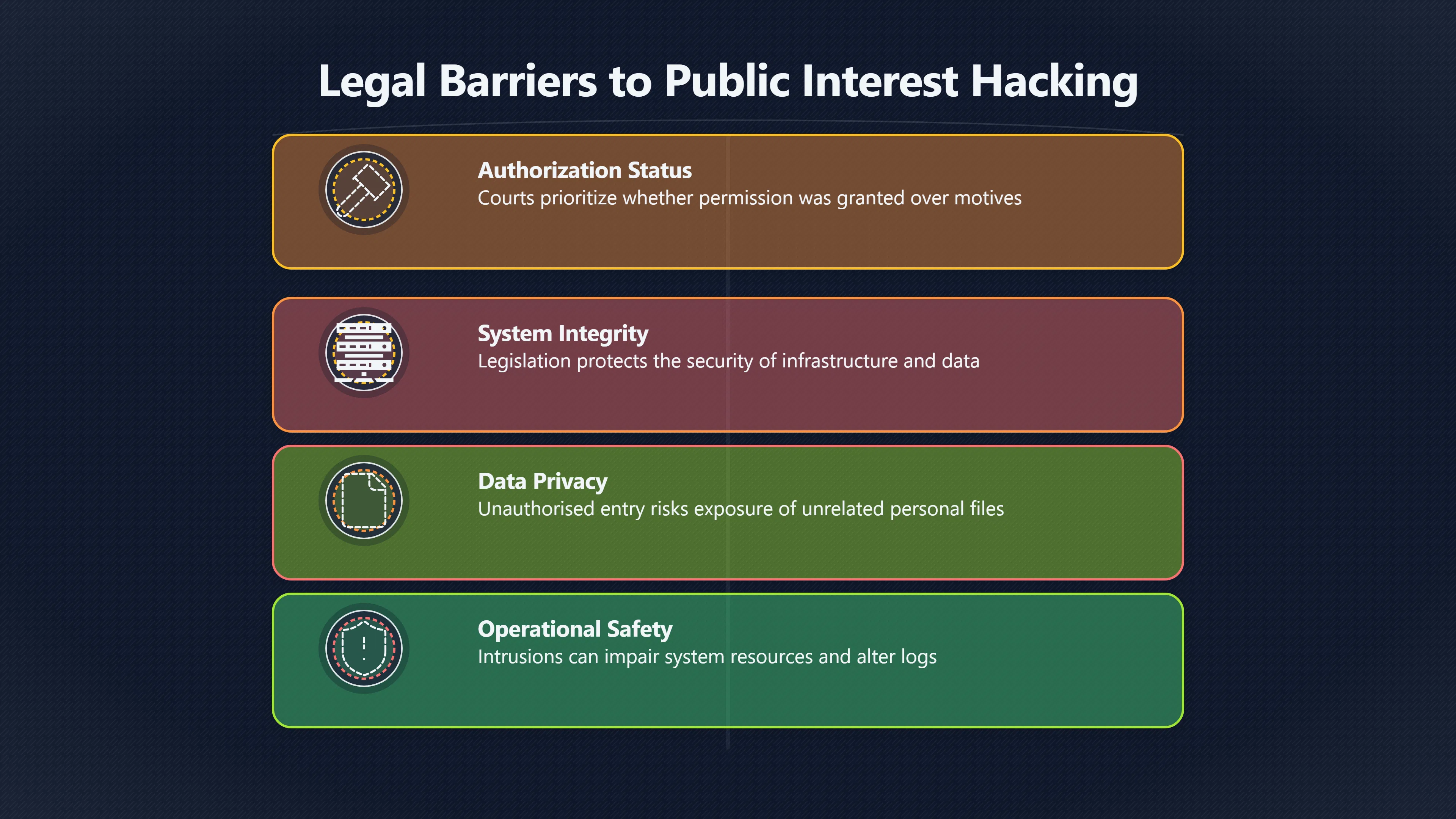
- No reliable way to verify motives beforehand. Authorities can observe unauthorised access, but they often cannot easily determine whether a claimed public-interest motive is genuine.
- Risk to unrelated information. Even a hacker searching for one category of information may encounter personal data, defence information, commercial secrets or operational systems.
- Potential system disruption. Access attempts can impair systems, consume resources, alter logs or create security risks regardless of the hacker’s intentions.
- Incentives for copycat behaviour. A broad public-interest exception could encourage many people to justify intrusions by asserting socially beneficial motives.[GOV.UK]GOV.UKReview of the Computer Misuse Act 1990: consultation and…14 Nov 2023 — The Act has the intention of protecting the integrity and secur…
These concerns help explain why courts and legislatures have historically focused on authorisation rather than subjective purpose. In the McKinnon litigation, legal proceedings revolved around allegations of unauthorised access to government computers, not whether his UFO-related motivations were sincere.[UK Parliament]publications.parliament.ukmckinn 1UK ParliamentMckinnon V Government of The United States of America…30 Jul 2008 — On 7 October 2004 the respondent government requested…
The Difference Between Whistleblowing and Hacking
A common misunderstanding is that whistleblowing and hacking are legally equivalent because both can reveal hidden information.
In practice, they are usually treated differently. A whistleblower often starts with authorised access and then discloses information obtained through a legitimate position inside an organisation. Hacking, by contrast, generally involves obtaining access that was never authorised in the first place.
This distinction helps explain why public-interest arguments sometimes carry weight in disclosure disputes but much less weight in hacking prosecutions. The law may debate whether information should eventually become public, yet still conclude that the method used to obtain it was unlawful. That separation between acquisition and disclosure is a recurring feature of computer-crime law.[GOV.UK]GOV.UKReview of the Computer Misuse Act 1990: consultation and…14 Nov 2023 — The Act has the intention of protecting the integrity and secur…
Alternative Reporting and Disclosure Routes
The fact that public-interest arguments rarely excuse hacking does not mean public concerns are irrelevant. Instead, legal systems generally encourage alternative channels.
These may include:
- Reporting concerns to journalists.
- Using whistleblower procedures where available.
- Submitting information to regulators, inspectors or oversight bodies.
- Participating in authorised vulnerability-disclosure programmes.
- Conducting security research with permission or within clearly defined legal frameworks.
The ongoing debate over reform of the Computer Misuse Act illustrates this distinction. Recent proposals and campaigns have argued for clearer protections for good-faith security researchers who test systems responsibly, but those proposals are typically framed around authorised or carefully limited research rather than a general right to hack whenever a person believes disclosure would benefit the public.[cyberupcampaign.com]cyberupcampaign.comI am therefore delighted to…Read more…
Even supporters of reform generally seek narrow, structured defences tied to legitimate cybersecurity work, not an unrestricted public-interest exemption that would allow individuals to decide for themselves which government or private systems they may access.[cyberupcampaign.com]cyberupcampaign.comI am therefore delighted to…Read more…
What the McKinnon Case Illustrates
The enduring significance of the McKinnon case is not that it resolved questions about UFOs. It is that it demonstrated how little weight public-interest motivations usually carry when evaluating unauthorised access.
McKinnon consistently argued that he was searching for information he believed was being concealed from the public, including alleged UFO evidence and advanced technologies. Yet the legal allegations focused on access to military and NASA systems, the scope of the intrusion, and the consequences attributed to it by US authorities. The central legal issue remained authorisation.[wikipedia.org]WikipediaGary Mc KinnonGary Mc Kinnon
For debates about curiosity-driven UFO hacking, that lesson is crucial. A belief that information is important, suppressed or even world-changing may explain why someone chooses to hack. It rarely provides legal authority to do so. The law generally treats the decision about what should be public as a matter for courts, legislatures, oversight mechanisms and authorised disclosure channels—not for individuals acting on their own judgement through unauthorised access.[gov.uk]GOV.UKReview of the Computer Misuse Act 1990: consultation and…14 Nov 2023 — The Act has the intention of protecting the integrity and secur…
Amazon book picks
Further Reading
Books and field guides related to Can Public Interest Ever Excuse a Hack?. Use these as the next step if you want deeper reading beyond the article.
Cybersecurity and Cyberwar
Addresses competing interests of security, law and public benefit.
This Is How They Tell Me the World Ends
Explores tensions between disclosure, secrecy and public interest.
The Cuckoo's Egg
Rating: 4.5/5 from 8 Google Books ratings
Examines the real-world effects of unauthorized access.
eBay marketplace picks
Marketplace Samples
Live-tested eBay searches with available results related to this page.



Endnotes
1.
Source: Wikipedia
Title: Gary [Mc Kinnon]({{ ‘mc-kinnon/’ | relative_url }})
Link:https://en.wikipedia.org/wiki/Gary_McKinnon
2.
Source: wired.com
Title: ufo hacker tells what he found
Link:https://www.wired.com/2006/06/ufo-hacker-tells-what-he-found/
Source snippet
'UFO Hacker' Tells What He Found21 Jun 2006 — 'UFO Hacker' Tells What He Found. The search for proof of the existence of UFOs landed Gary...
3.
Source: cps.gov.uk
Title: computer misuse act
Link:https://www.cps.gov.uk/prosecution-guidance/computer-misuse-act
Source snippet
Crown Prosecution ServiceComputer Misuse Act5 Feb 2020 — The offence is made out once a defendant has caused a computer, which would incl...
4.
Source: GOV.UK
Link:https://www.gov.uk/government/consultations/review-of-the-computer-misuse-act-1990/review-of-the-computer-misuse-act-1990-consultation-and-response-to-call-for-information-accessible
Source snippet
Review of the Computer Misuse Act 1990: consultation and...14 Nov 2023 — The Act has the intention of protecting the integrity and secur...
5.
Source: spectrum.ieee.org
Link:https://spectrum.ieee.org/the-autistic-hacker
Source snippet
IEEE SpectrumGary McKinnon: The Autistic HackerMcKinnon claimed that UFOs were the reason for his hack. Convinced that the government was...
6.
Source: publications.parliament.uk
Title: mckinn 1
Link:https://publications.parliament.uk/pa/ld200708/ldjudgmt/jd080730/mckinn-1.htm
Source snippet
UK ParliamentMckinnon V Government of The United States of America...30 Jul 2008 — On 7 October 2004 the respondent government requested...
Published: October 2004
7.
Source: computerweekly.com
Title: Computer Misuse Act reform is overdue
Link:https://www.computerweekly.com/opinion/Computer-Misuse-Act-reform-is-overdue-not-all-anniversaries-should-be-celebrated
Source snippet
not all...9 Jan 2026 — The purpose of seeking to introduce a statutory defence is to provide legal clarity and protection for ethical cy...
8.
Source: clrnn.co.uk
Title: clrnn cma report
Link:https://www.clrnn.co.uk/media/1018/clrnn-cma-report.pdf
Source snippet
Reforming the Computer Misuse Act 1990ImmigraDon Act 2008 was set to insert a subjecDve public interest defence into the. DPA 1998, but i...
9.
Source: bills.parliament.uk
Link:https://bills.parliament.uk/publications/60406/documents/6385
Source snippet
on the Crime and Policing Bill: a critical opportunity...The CyberUp Campaign is calling for a long-overdue update to the Computer Misus...
10.
Source: Wikipedia
Link:https://en.wikipedia.org/wiki/Computer
Source snippet
ComputerA computer is a machine that can be programmed to automatically carry out sequences of arithmetic or logical operations (compu...
11.
Source: Wikipedia
Title: Computer Misuse Act 1990
Link:https://en.wikipedia.org/wiki/Computer_Misuse_Act_1990
Source snippet
Computer Misuse Act 1990Section 35. Unauthorised access to computer material, punishable by up to two years in prison or a fine or bot...
12.
Source: cyberupcampaign.com
Link:https://www.cyberupcampaign.com/news/cyber-up-campaign-welcomes-chancellors-budget-commitment-to-computer-misuse-act-reform
Source snippet
I am therefore delighted to...Read more...
13.
Source: handleygill.co.uk
Title: cma 1990 statutory public interest defence
Link:https://www.handleygill.co.uk/handley-gill-blog/cma-1990-statutory-public-interest-defence
Source snippet
Licence to hack?4 Jul 2023 — “The government has confirmed that it intends to pursue the introduction of a statutory public interest defe...
14.
Source: southeastcyber.police.uk
Title: computer misuse act
Link:https://southeastcyber.police.uk/computer-misuse-act/
Source snippet
The Computer Misuse Act 1990Section 2 of the Computer Misuse Act makes it illegal to gain unauthorised access to a computer with the inte...
15.
Source: freeprivacypolicy.com
Title: computer misuse act 1990
Link:https://www.freeprivacypolicy.com/blog/computer-misuse-act-1990/
Source snippet
The Computer Misuse Act 1990Feb 25, 2025 — In other words, it's a crime to make the hacking tools even if you don't hack a computer yours...
16.
Source: open.edu
Link:https://www.open.edu/openlearn/ocw/mod/oucontent/view.php?id=80038§ion=_unit8.3.3
Source snippet
2.3 The Computer Misuse Act 1990 (CMA)The CMA came about, in part, because of a 1988 case where two hackers broke into the British Teleco...
Additional References
17.
Source: justice.gov
Link:https://www.justice.gov/archive/criminal/cybercrime/press-releases/2002/mckinnonIndict.htm
Source snippet
Department of JusticeLondon, England Hacker Indicted Under Computer Fraud...Gary McKinnon, of London, England, was indicted in Alexandri...
18.
Source: reddit.com
Link:https://www.reddit.com/r/hacking/comments/1etqs6b/how_gary_mckinnon_did_what_he_did/
19.
Source: cyfor.co.uk
Link:https://cyfor.co.uk/the-computer-misuse-act-and-cyber-crime/
Source snippet
The Computer Misuse Act and Cyber CrimeThe Computer Misuse Act protects data from unauthorised access and is imposed against cybercrimina...
20.
Source: malicious.life
Link:https://malicious.life/episode/us_vs_gary_mckinnon/
Source snippet
The US vs. Gary McKinnonAlien or government-made, this had to be a UFO. As the high-resolution image slowly downloaded to his computer, t...
21.
Source: linkedin.com
Link:https://www.linkedin.com/posts/cyberup-campaign_cyberup-reformthecma-cybersecurity-activity-7432356218829967360-oN0p
Source snippet
UK Government Considers Reforming Computer Misuse ActThe new clause places a duty on the government to review within 12 months whether ou...
22.
Source: technologyslegaledge.com
Link:https://www.technologyslegaledge.com/2021/07/a-blunted-sword-and-a-chipped-shield-a-call-for-development-to-the-computer-misuse-act-1990/
Source snippet
A call for development to the Computer Misuse Act 19908 Jul 2021 — Since its inception 30 years ago, the Computer Misuse Act 1990 (CMA) h...
23.
Source: ikandp.co.uk
Link:https://www.ikandp.co.uk/computer-misuse-act-offences
Source snippet
mputer Misuse Act OffencesSection 3 covers unauthorised acts to impair the operation of a computer. This is also known as a cyber-attac...
24.
Source: researchgate.net
Link:https://www.researchgate.net/publication/323786681_The_Computer_Misuse_Act_1990_to_support_vulnerability_research_Proposal_for_a_defence_for_hacking_as_a_strategy_in_the_fight_against_cybercrime
Source snippet
Hacking would have become illegal only in three situations: when the hacker intended. to 'procur[e] an advantage...Read more...
25.
Source: welivesecurity.com
Title: gary mckinnon reveals detail on nasa data breach and extraterrestrial life
Link:https://www.welivesecurity.com/2015/12/08/gary-mckinnon-reveals-detail-on-nasa-data-breach-and-extraterrestrial-life/
Source snippet
Gary McKinnon reveals detail on NASA data breach and '...8 Dec 2015 — IT expert Gary McKinnon candidly revealed detail on his NASA data...
26.
Source: kalw.org
Title: u k blocks extradition of hacker accused of accessing pentagon computers
Link:https://www.kalw.org/2012-10-16/u-k-blocks-extradition-of-hacker-accused-of-accessing-pentagon-computers
Source snippet
Blocks Extradition Of Hacker Accused Of Accessing...16 Oct 2012 — Gary McKinnon, who the U.S. government says perpetrated the biggest mi...
Topic Tree
Follow this branch
Parent topic
Legal Limits When Curiosity Becomes a Computer CrimeRelated pages 5
- CFAA Case What Mc Kinnon's US Charges Were Really About
- Damage Threshold When Looking Becomes Legally More Serious
- Harmless Exploration Why 'Just Exploring' Can Still Be Illegal
- Research Limits When Does Security Research Stop Being Research?
- Sensitive Targets Why Defence Networks Trigger Greater Legal Risk