Within UFO Hackers
How Would UFO Hacker Evidence Be Proved?
Claims from hacked systems need files, metadata, provenance, witnesses, and public authentication before they become evidence.
On this page
- Files and metadata
- Chain of custody
- Corroboration and authentication
Page outline Jump by section
Introduction
Alleged UFO evidence from hackers such as Gary McKinnon should not be treated as proved simply because the claimed source was a restricted NASA or military system. It would need the same evidential scaffolding as any serious digital claim: original files, intact metadata, a defensible chain of custody, independent witnesses, technical authentication, and public corroboration against known records. In McKinnon’s case, the hacking and prosecution record are documented, but the most famous UFO claims — a supposed NASA image and a spreadsheet headed “Non-Terrestrial Officers” — remain claims described in interviews rather than files the public can inspect.[WIRED]wired.comufo hacker tells what he foundWIRED'UFO Hacker' Tells What He Found21 Jun 2006 — McKinnon tells what he found and discusses the motivation behind his online adventures…
That distinction matters because a hacked origin can make a story more exciting while making verification harder. Illegally obtained material may be incomplete, altered, misremembered, mislabelled, stripped of context, or impossible to authenticate without exposing sources and methods. The central question is not “could a hacker have seen something strange?” but “can the alleged artefact be independently shown to be what it is claimed to be?”
What Would Count as the Original Evidence?
For a UFO hacker claim to move beyond anecdote, the first requirement would be the actual digital artefact: the image, spreadsheet, database export, email, log, directory listing, or system record that allegedly proves the claim. A verbal description is not enough, even if it is detailed. In McKinnon’s case, Wired reported his account that he briefly viewed a NASA image of a “cigar-shaped” object and saw a file or spreadsheet titled “Non-Terrestrial Officers”, but the public record does not include the original image, the spreadsheet, a verifiable file path, or a captured forensic copy.[WIRED]wired.comufo hacker tells what he foundWIRED'UFO Hacker' Tells What He Found21 Jun 2006 — McKinnon tells what he found and discusses the motivation behind his online adventures…
A credible release would preserve the file in its closest available original form. For an image, that means the original file rather than a screenshot, social media repost, cropped still, recompressed JPEG, or video of a monitor. For a spreadsheet, it means the native workbook or database export, not a retyped list. For a directory claim, it means listings with timestamps, permissions, paths, system names, and enough surrounding context to show where the item sat inside the network.
The evidence would also need internal consistency. A purported NASA image should have technical characteristics consistent with the claimed camera, mission, processing pipeline, archive format, and date. A purported military personnel file should use plausible naming conventions, ranks, units, document markings, classification banners, and distribution controls for the period. A single dramatic phrase, such as “non-terrestrial”, would not be enough on its own, because bureaucratic language can be ambiguous without the full document and its surrounding records.
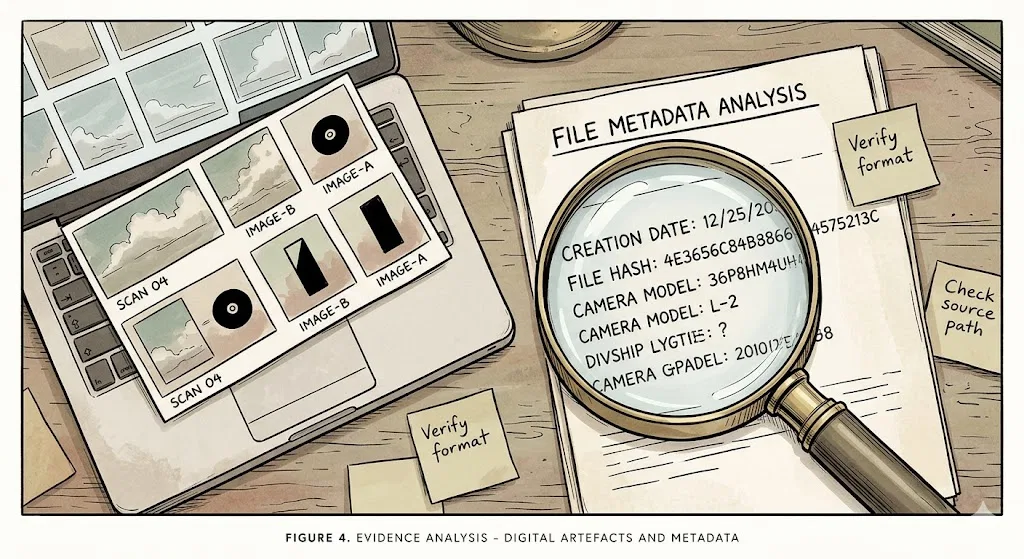
Files and Metadata
Metadata is not magic proof, but it is often where a claim first starts to become testable. It can record when a file was created, modified, exported, encoded, compressed, or opened; which software handled it; what device or system generated it; and whether it has passed through later editing tools. The Scientific Working Group on Digital Evidence’s guidance on video authentication stresses that provenance analysis looks at the history of the file and that encoding structure and metadata can help show what software last interacted with it.[SWGDE - SWGDE]swgde.org2024 03 07 SWGDE Best Practices for Digital Video Authentication 23 V 001 1.2SWGDESWGDE 23-V-001-1.2 Best Practices for Digital Video…7 Mar 2024 — Contextualization as it relates to video authentication…
For alleged UFO hacker evidence, useful metadata would include:
- File hashes: cryptographic fingerprints, such as SHA-256 hashes, taken as early as possible to show whether later copies match the first preserved copy.
- Creation and modification dates: not as final proof, but as clues to whether the file fits the claimed system, mission, or incident.
- Path and system context: directories, hostnames, user accounts, access permissions, archive labels, and related files.
- Format history: signs of conversion, recompression, screen capture, editing software, export tools, or copying between systems.
- Embedded source data: camera, sensor, spreadsheet authoring, database, or document properties that can be compared with known institutional practice.
The weakness is that metadata can be missing, misleading, or manipulated. A hacker may only have seen a low-resolution preview, may have viewed a file through a remote session, or may have saved a damaged copy. Conversely, a hoaxer can fabricate plausible-looking metadata. That is why metadata matters most when it aligns with independent evidence: logs from the source system, known file formats, matching archive records, witnesses, and a documented preservation history.
NASA’s own UAP study shows why metadata is central to the wider UFO evidence problem. The 2023 independent study report said UAP analysis is hampered by poor sensor calibration, lack of multiple measurements, lack of sensor metadata, and lack of baseline data. That point applies even more strongly to hacker claims, where the alleged data may be a fragment separated from its original technical environment.[NASA Science]science.nasa.govScience Independent Study Team ReportNASA ScienceIndependent Study Team ReportSeptember 13, 2023 — At present, analysis of UAP data is hampered by poor sensor calibration, th…

Chain of Custody
Chain of custody is the record of who had the evidence, when they had it, what they did with it, and how it was protected from alteration. In ordinary digital forensics, this is not a decorative formality; it is what allows later reviewers to distinguish a preserved artefact from a rumour, a copy, or an edited derivative.
NIST’s digital forensics guidance emphasises that organisations should handle evidence in a forensically sound manner, preserve the integrity of records, and be ready to demonstrate the reliability and integrity of logs and electronic records because they can be altered or manipulated.[NIST Publications]nvlpubs.nist.govPublications NIST SP 800-86, Guide to Integrating Forensic TechniquesPublications NIST SP 800-86, Guide to Integrating Forensic Techniques SWGDE guidance similarly says examiners should document chain of custody for acquired data, especially when digital evidence is transferred between people.[SWGDE - SWGDE]swgde.orgBest Practices for Remote Collection of Digital EvidenceBest Practices for Remote Collection of Digital Evidence
In the UFO hacker context, a defensible chain would answer practical questions:
- Who first obtained the file? A named person, device, account, or forensic acquisition process is stronger than an anonymous repost.
- How was it captured? A forensic image of a drive, packet capture, secure export, or preserved original is stronger than a phone photo of a screen.
- When was it sealed? Early hashing and timestamping reduce the risk that later edits are mistaken for original content.
- Who handled it afterwards? Each transfer should be logged, including analysts, journalists, lawyers, researchers, and platforms.
- Can another examiner reproduce the finding? Independent experts should be able to verify that the file they examine matches the preserved copy.
McKinnon’s UFO claims fail at this stage as public evidence. The legal record supports that he was accused of accessing many US government computers, but the UFO material he described has not been released with a chain of custody. The Department of Justice alleged unauthorised access and damage involving US Army, Navy, Air Force, Department of Defense and NASA computers; it did not authenticate a UFO discovery.[Department of Justice]justice.govDepartment of JusticeLondon, England Hacker Indicted Under Computer Fraud…Gary McKinnon, of London, England, was indicted in Alexandri…
Corroboration and Authentication
A single file rarely proves an extraordinary claim by itself. Strong authentication would require corroboration from independent routes that do not all depend on the same person or the same copied artefact. This is especially important for hacked material, because the audience cannot assume that a file’s apparent location, title, or contents mean what they seem to mean.
For a claimed NASA UFO image, corroboration might include matching mission records, image catalogues, sensor specifications, timestamps, orbital geometry, telemetry, processing logs, and archive identifiers. For a claimed personnel spreadsheet, corroboration might include document-control numbers, classification markings, distribution lists, personnel systems, ship or unit records, and testimony from people able to explain the terminology. If the claim is that an image was airbrushed or altered, the key comparison would be between the alleged original, the public release, and the processing history linking the two.
Independent visual verification methods can also help, but they have limits. Journalistic verification guides often look at the source, date, location, provenance, and motivation behind an image or video, while open-source investigators preserve public material quickly because online evidence can be deleted or changed.[First Draft]firstdraftnews.orgFirst Draft VISUAL VERIFICATION GUIDE PHOTOS | First Draft NewsFirst Draft VISUAL VERIFICATION GUIDE PHOTOS | First Draft News Those methods are useful for testing whether a video was posted when and where it was claimed, but a hacked government file needs a deeper technical layer: system provenance, institutional context, and access history.
Authentication also means testing ordinary explanations before exotic ones. A term such as “non-terrestrial” might sound like “alien” in popular retellings, but in a technical or defence context it could refer to space-based systems, simulations, exercises, non-ground assignments, maritime transfers, internal categories, or something else entirely. McKinnon himself reportedly acknowledged uncertainty about whether the material he saw could have been a game or exercise.[WIRED]wired.comufo hacker tells what he foundWIRED'UFO Hacker' Tells What He Found21 Jun 2006 — McKinnon tells what he found and discusses the motivation behind his online adventures…
Why Screenshots and Memories Are Weak Evidence
Many UFO hacker stories circulate as recollections rather than records. That is understandable: an intruder may have been disconnected, afraid of being caught, or unable to download large files. But evidentially, memory is weak. A person can sincerely misread a file title, misunderstand a technical system, exaggerate later significance, or conflate details from multiple sessions.
Screenshots are only slightly stronger unless they are preserved with context. A screenshot can show what appeared on one display at one moment, but it may not prove the source system, original file, full metadata, surrounding directory, or whether the screen content was altered. A screenshot also strips out much of the information investigators need: native file structure, embedded metadata, access logs, and hashable originals.
This is why professional verification starts with the most original recoverable version, not the most dramatic presentation. A low-quality copy can be a lead, but it should not become the whole case. The stronger route is to secure the native file, hash it, record its provenance, preserve related logs, and allow qualified reviewers to test whether the content fits the claimed source.

Public Authentication Without Exposing Sensitive Systems
There is a real tension in this topic: if a file were genuinely taken from a classified or restricted system, publishing every detail might create legal, security, or privacy problems. But that does not make public authentication impossible. It means the process has to separate sensitive operational details from the evidence needed to evaluate the claim.
A credible public pathway could include redacted but reviewable materials, independent examination by trusted technical experts, sworn witness statements, court-supervised handling, congressional or parliamentary review, or release through official declassification and freedom-of-information channels. The public does not necessarily need live credentials, classified network diagrams, or unredacted personal data. It does need enough to know that the artefact is real, unaltered, correctly interpreted, and not merely a story.
Recent official UAP work illustrates the difference between collecting reports and proving extraordinary interpretations. AARO’s FY2024 annual report said it received 757 UAP reports for the covered period and earlier unreported periods, while its historical review said it had found no empirical evidence that US government or private-sector investigations had confirmed extraterrestrial technology.[U.S. Department of War]media.defense.govFY24 CONSOLIDATED ANNUAL REPORT ON UAP 508FY24 CONSOLIDATED ANNUAL REPORT ON UAP 508 Those findings do not prove that every unusual report has a mundane explanation, but they do show the standard official investigators claim to apply: reports require data quality, correlation, and analysis before they become conclusions.

A Practical Credibility Scale
A useful way to assess alleged UFO hacker evidence is to grade the claim by what is available, not by how interesting it sounds.
Lowest credibility: story only.
A person says they saw a file, image, list, or database, but no artefact is available. McKinnon’s best-known UFO claims currently sit here for the public: they are notable because of who made them and the documented hacking case, but the alleged UFO files are not publicly inspectable.[WIRED]wired.comufo hacker tells what he foundWIRED'UFO Hacker' Tells What He Found21 Jun 2006 — McKinnon tells what he found and discusses the motivation behind his online adventures…
Lead, not proof: screenshot or retelling with partial context.
A screenshot, transcript, or copied text may justify further inquiry, especially if it contains specific names, dates, file paths, or identifiers. It still needs native files, metadata, and corroboration before it can bear much weight.
Moderate credibility: native file with plausible metadata.
The original or near-original file exists, hashes are recorded, and metadata is consistent with the claimed system. This is stronger, but it remains vulnerable if the source path, acquisition method, and institutional context are missing.
Stronger credibility: file plus chain of custody and independent analysis.
The artefact is preserved, transfers are documented, experts can reproduce findings, and alternative explanations have been tested. This is where a claim begins to look like evidence rather than internet lore.
Highest credibility: independent public authentication.
Multiple sources converge: official records, logs, witnesses, technical metadata, archive matches, and expert review all support the same interpretation. For an extraordinary UFO claim, this is the level that would be needed before public confidence should shift.
The McKinnon Lesson
The McKinnon case is a useful caution because it combines two very different evidential categories. The intrusion allegations are documented in legal and government sources. The UFO discoveries are not documented in the same way. The US Department of Justice described an indictment involving unauthorised access to numerous military and NASA systems; later UK coverage documented the extradition dispute and the decision not to pursue UK charges.[justice.gov]justice.govDepartment of JusticeLondon, England Hacker Indicted Under Computer Fraud…Gary McKinnon, of London, England, was indicted in Alexandri… None of that authenticates the alleged NASA image or the “Non-Terrestrial Officers” spreadsheet.
That does not mean McKinnon invented everything he described. It means the public cannot fairly treat his account as proved. The most defensible position is narrower: he is an important figure in the history of UFO-related hacking claims, but his alleged discoveries remain unverified because the files, metadata, chain of custody, and independent authentication have not been produced.
For readers, the lesson is simple but powerful. A hacked source is not a shortcut around evidence standards. It raises the need for them. The more dramatic the claimed discovery, the more important it becomes to ask for the original file, the technical context, the preservation trail, the witnesses, and the independent checks that would allow the claim to survive scrutiny outside the story that made it famous.
Amazon book picks
Further Reading
Books and field guides related to How Would UFO Hacker Evidence Be Proved?. Use these as the next step if you want deeper reading beyond the article.
eBay marketplace picks
Marketplace Samples
Example marketplace items related to this page. Use the search link to explore similar finds on eBay.




Endnotes
1.
Source: wired.com
Title: ufo hacker tells what he found
Link:https://www.wired.com/2006/06/ufo-hacker-tells-what-he-found/
Source snippet
WIRED'UFO Hacker' Tells What He Found21 Jun 2006 — McKinnon tells what he found and discusses the motivation behind his online adventures...
2.
Source: justice.gov
Link:https://www.justice.gov/archive/criminal/cybercrime/press-releases/2002/mckinnonIndict.htm
Source snippet
Department of JusticeLondon, England Hacker Indicted Under Computer Fraud...Gary McKinnon, of London, England, was indicted in Alexandri...
3.
Source: swgde.org
Title: 2024 03 07 SWGDE Best Practices for Digital Video Authentication 23 V 001 1.2
Link:https://www.swgde.org/wp-content/uploads/2024/03/2024-03-07-SWGDE-Best-Practices-for-Digital-Video-Authentication-23-V-001-1.2.pdf
Source snippet
SWGDESWGDE 23-V-001-1.2 Best Practices for Digital Video...7 Mar 2024 — Contextualization as it relates to video authentication...
4.
Source: science.nasa.gov
Title: Science Independent Study Team Report
Link:https://science.nasa.gov/wp-content/uploads/2023/09/uap-independent-study-team-final-report.pdf
Source snippet
NASA ScienceIndependent Study Team ReportSeptember 13, 2023 — At present, analysis of UAP data is hampered by poor sensor calibration, th...
Published: September 13, 2023
5.
Source: nasa.gov
Title: update nasa shares uap independent study report names director
Link:https://www.nasa.gov/news-release/update-nasa-shares-uap-independent-study-report-names-director/
6.
Source: nvlpubs.nist.gov
Title: Publications NIST SP 800-86, Guide to Integrating Forensic Techniques
Link:https://nvlpubs.nist.gov/nistpubs/Legacy/SP/nistspecialpublication800-86.pdf
7.
Source: csrc.nist.gov
Link:https://csrc.nist.gov/pubs/sp/800/86/final
8.
Source: swgde.org
Title: Best Practices for Remote Collection of Digital Evidence
Link:https://www.swgde.org/documents/published-complete-listing/22-f-003-best-practices-for-remote-collection-of-digital-evidence-from-an-endpoint/
9.
Source: media.defense.gov
Title: FY24 CONSOLIDATED ANNUAL REPORT ON UAP 508
Link:https://media.defense.gov/2024/Nov/14/2003583603/-1/-1/0/FY24-CONSOLIDATED-ANNUAL-REPORT-ON-UAP-508.PDF
10.
Source: media.defense.gov
Title: DOPSR 2024 0263 AARO HISTORICAL RECORD REPORT VOLUME 1 2024
Link:https://media.defense.gov/2024/Mar/08/2003409233/-1/-1/0/DOPSR-2024-0263-AARO-HISTORICAL-RECORD-REPORT-VOLUME-1-2024.PDF
11.
Source: science.nasa.gov
Link:https://science.nasa.gov/uap/
12.
Source: nvlpubs.nist.gov
Link:https://nvlpubs.nist.gov/nistpubs/ir/2022/NIST.IR.8387.pdf
13.
Source: aaro.mil
Link:https://www.aaro.mil/UAP-Cases/Official-UAP-Imagery/
14.
Source: aaro.mil
Link:https://www.aaro.mil/
15.
Source: aaro.mil
Title: UAP Records
Link:https://www.aaro.mil/UAP-Records/
16.
Source: justice.gov
Link:https://www.justice.gov/archive/criminal/cybercrime/press-releases/2002/mckinnonIndict2.htm
17.
Source: war.gov
Title: department of defense releases the annual report on unidentified anomalous phen
Link:https://www.war.gov/News/Releases/Release/Article/3964824/department-of-defense-releases-the-annual-report-on-unidentified-anomalous-phen/
18.
Source: lab.witness.org
Link:https://lab.witness.org/portfolio_page/verification/
19.
Source: swgde.org
Title: Best Practices for Digital Video Authentication
Link:https://www.swgde.org/documents/published-complete-listing/23-v-001-best-practices-for-digital-video-authentication/
20.
Source: wired.com
Title: brit accused of hacking pentagon
Link:https://www.wired.com/2002/11/brit-accused-of-hacking-pentagon/
21.
Source: wired.com
Title: terrorist or ufo truth seeker
Link:https://www.wired.com/2006/04/terrorist-or-ufo-truth-seeker/
22.
Source: firstdraftnews.org
Title: First Draft VISUAL VERIFICATION GUIDE PHOTOS | First Draft News
Link:https://firstdraftnews.org/wp-content/uploads/2017/03/FDN_verificationguide_photos.pdf
23.
Source: theguardian.com
Title: gary mckinnon no uk charges
Link:https://www.theguardian.com/world/2012/dec/14/gary-mckinnon-no-uk-charges
24.
Source: theguardian.com
Title: gary mckinnon feels set free
Link:https://www.theguardian.com/world/2012/oct/17/gary-mckinnon-feels-set-free
25.
Source: theguardian.com
Link:https://www.theguardian.com/theguardian/2005/jul/09/weekend7.weekend2
26.
Source: theguardian.com
Title: gary mckinnon hacker sparked storm
Link:https://www.theguardian.com/world/2012/oct/16/gary-mckinnon-hacker-sparked-storm
27.
Source: theguardian.com
Title: gary [mckinnon extradition]({{ ‘reform/’ | relative_url }}) timeline
Link:https://www.theguardian.com/world/2009/nov/26/gary-mckinnon-extradition-timeline
28.
Source: Wikipedia
Title: Gary Mc Kinnon
Link:https://en.wikipedia.org/wiki/Gary_McKinnon
29.
Source: firstdraftnews.org
Link:https://firstdraftnews.org/wp-content/uploads/2021/03/First-Draft-Vaccine-Insights-Flexible-Learning-Course-6.pdf
30.
Source: GOV.UK
Title: gary mckinnon extradition case home secretarys statement
Link:https://www.gov.uk/government/speeches/gary-mckinnon-extradition-case-home-secretarys-statement
31.
Source: criminal.laws.com
Title: gary mckinnon
Link:https://criminal.laws.com/gary-mckinnon
Additional References
32.
Source: youtube.com
Title: The Man Who Hacked the U.S. Government
Link:https://www.youtube.com/watch?v=ND0zQX1rGdg
Source snippet
Ancient Aliens: Hacking NASA Secrets (Season 12, Episode 9) | History...
33.
Source: digital-detective.net
Link:https://www.digital-detective.net/digital-forensics-documents/ACPO_Good_Practice_Guide_for_Digital_Evidence_v5.pdf
34.
Source: scribd.com
Link:https://www.scribd.com/document/794604803/eccouncil-ecihv2-3-2-1-principles-of-digital-evidence-collection
35.
Source: medium.com
Link:https://medium.com/1st-draft/are-you-a-journalist-download-this-free-guide-for-verifying-photos-and-videos-f39022fe9c3b
36.
Source: gijn.org
Link:https://gijn.org/stories/document-day-bellingcats-digital-forensics-tools/
37.
Source: bluelinehub.co.uk
Link:https://bluelinehub.co.uk/guides/digital-evidence-basics
38.
Source: cyfor.co.uk
Link:https://cyfor.co.uk/corporate-forensic-investigations/document-analysis-authentication/
39.
Source: uh.edu
Link:https://uh.edu/~pkoya/6322/assignments6322/NIST%20800-86.htm
40.
Source: instagram.com
Link:https://www.instagram.com/reel/DTveyiaANbn/
41.
Source: podmust.com
Link:https://podmust.com/ep/?epis=R2FyeSBNY0tpbm5vbjogVGhlIEhhY2tlciBXaG8gRm91bmQgTkFTQSdzIFVGTyAmIE5vbi1UZXJyZXN0cmlhbCBPZmZpY2Vycw%3D%3D&podcast=the-daily-conspiracy
Topic Tree