Within Legal Limits
What Mc Kinnon's US Charges Were Really About
The US case against McKinnon shows how federal law approaches unauthorised access and alleged damage.
On this page
- The indictment and alleged conduct
- Access, damage and federal offences
- Why motive did not resolve liability
Page outline Jump by section
Introduction
Gary McKinnon’s case is often discussed in connection with his claim that he was searching for evidence of UFOs and hidden government technologies. Legally, however, the United States did not treat the case as a dispute about UFOs. It treated it as a computer intrusion case under the Computer Fraud and Abuse Act (CFAA), the main US federal anti-hacking statute. The central question under the CFAA was whether McKinnon had accessed protected computers without authorisation and caused damage or loss, not why he said he entered the systems. The way the CFAA was applied to McKinnon illustrates a broader principle in cybercrime law: curiosity, political interest or unconventional motives do not automatically excuse unauthorised access.[Department of Justice]justice.govmckinnon IndictDepartment of JusticeLondon, England Hacker Indicted Under Computer Fraud…According to the indictment, between March of 2001 and March…
What the Indictment Alleged
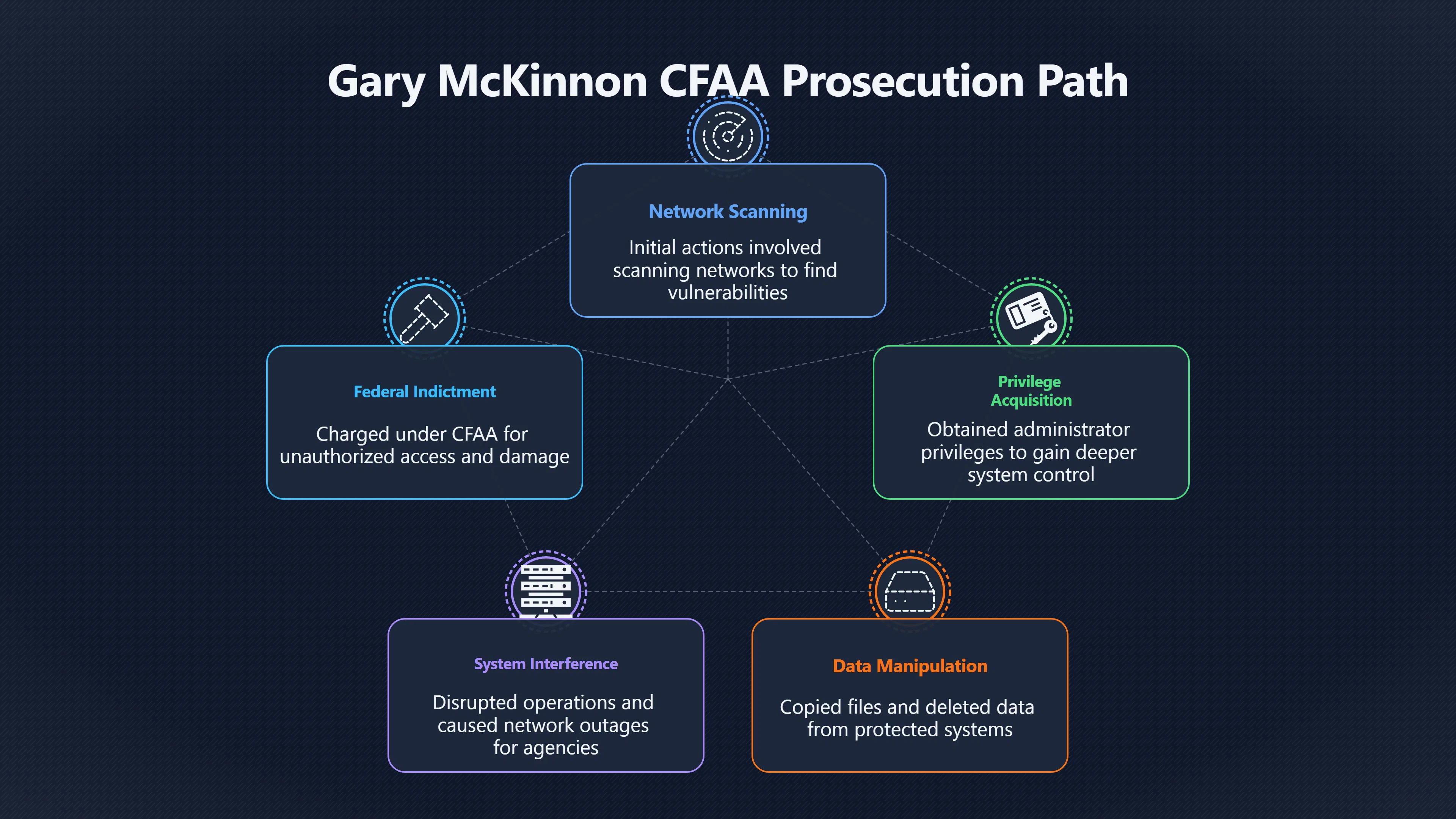
In November 2002, a federal grand jury in the Eastern District of Virginia returned an indictment charging McKinnon under 18 U.S.C. §1030, the Computer Fraud and Abuse Act. The indictment alleged that between March 2001 and March 2002 he accessed and damaged 92 computers belonging to the US Army, Navy, Air Force, Department of Defense and NASA, as well as several private-sector computers. Prosecutors also alleged that one of the affected systems was used for national defence and security purposes.[Department of Justice]justice.govmckinnon IndictDepartment of JusticeLondon, England Hacker Indicted Under Computer Fraud…According to the indictment, between March of 2001 and March…
The charging documents did not focus on UFO-related claims. Instead, they described a pattern of scanning networks, obtaining unauthorised access, acquiring administrator privileges, copying files and passwords, deleting data and interfering with system operations. From the government’s perspective, these actions brought the conduct squarely within the CFAA’s prohibitions on unauthorised access and computer damage.[Department of Justice]justice.govedva mckinnon indictmentDepartment of JusticeIndictment**. GARY MCKINNON. Defendant. } Criminal No. } 18 U.S.C. § 1030. } Fraud and Related Activity in. Connect…
The Virginia indictment contained seven computer-related counts under the CFAA. Separate proceedings in New Jersey also concerned alleged damage to a naval weapons system computer. Prosecutors therefore viewed the conduct not as a single isolated intrusion but as a series of offences involving multiple federal systems.[Department of Justice]justice.govDepartment of Justice British National Charged with Hacking Into N.Jseven-count Virginia Indictment charges McKinnon for intrusions into 92 computer systems belonging to the U.S. Army, Navy, A…
Access, Damage and Federal Offences
Why unauthorised access mattered
The CFAA was originally enacted to protect government and other protected computers from unauthorised access. In McKinnon’s case, prosecutors argued that the key legal threshold had been crossed once he entered systems he had no authority to use. Whether the systems were poorly secured or vulnerable did not eliminate the requirement for authorisation.[Department of Justice]justice.govedva mckinnon indictmentDepartment of JusticeIndictment**. GARY MCKINNON. Defendant. } Criminal No. } 18 U.S.C. § 1030. } Fraud and Related Activity in. Connect…
This distinction became important because some public discussion of the case focused on claims that weak passwords and insecure configurations had made access relatively easy. The indictment nevertheless treated entry into those systems as unauthorised access under federal law. The legal theory was not that McKinnon had stolen classified secrets, but that he had knowingly entered and interfered with computers that belonged to protected federal networks.[Department of Justice]justice.govedva mckinnon indictmentDepartment of JusticeIndictment**. GARY MCKINNON. Defendant. } Criminal No. } 18 U.S.C. § 1030. } Fraud and Related Activity in. Connect…

Why alleged damage increased the stakes
The CFAA draws a significant distinction between merely accessing a computer and causing damage or loss. Prosecutors alleged that McKinnon deleted files, disrupted systems and contributed to network outages. Government statements connected the alleged intrusions to substantial remediation costs and operational disruption.[justice.gov]justice.govmckinnon IndictDepartment of JusticeLondon, England Hacker Indicted Under Computer Fraud…According to the indictment, between March of 2001 and March…
Because the indictment alleged damage rather than simple viewing of information, the case moved into the more serious territory of federal computer crime enforcement. The government’s public statements emphasised the impact on military and NASA systems rather than any information McKinnon claimed to have discovered.[Department of Justice]justice.govmckinnon IndictDepartment of JusticeLondon, England Hacker Indicted Under Computer Fraud…According to the indictment, between March of 2001 and March…
National-security computers received special attention
One notable feature of the case was the allegation that at least one affected computer was used for military national-defence and security functions. That allegation did not transform the case into an espionage prosecution, but it did increase the seriousness with which federal authorities viewed the conduct. Systems connected to defence functions have historically attracted particularly aggressive enforcement under the CFAA.[U.S. Department of War]media.defense.govMc Kinnon comphackerDepartment of WarU.S. Department of Justice United States Attorney Eastern…12 Nov 2002 — One count charges McKinnon with accessing wit…
Why Motive Did Not Resolve Liability
A recurring public misunderstanding is that McKinnon’s stated UFO-related motivation should have altered the legal analysis. Under the CFAA, however, motive and authorisation are different questions.
McKinnon publicly maintained that he was searching for evidence relating to UFOs, anti-gravity technology and government secrecy rather than seeking financial gain. Yet the indictment did not require prosecutors to prove a conventional criminal motive such as theft, espionage or fraud. The government’s burden was to prove the elements of the computer offences, including unauthorised access and the alleged damage to protected computers.[Wikipedia]WikipediaGary Mc KinnonGary Mc Kinnon
This aspect of the case explains why it became a landmark example in discussions of curiosity-driven hacking. Even if a defendant argues that the objective was research, investigation or disclosure rather than profit, the CFAA can still apply if the access itself was unauthorised. The statute focuses primarily on conduct involving protected computer systems rather than on whether the defendant believed the purpose was justified.[Department of Justice]justice.govedva mckinnon indictmentDepartment of JusticeIndictment**. GARY MCKINNON. Defendant. } Criminal No. } 18 U.S.C. § 1030. } Fraud and Related Activity in. Connect…
The contrast between McKinnon’s public explanation and the government’s legal theory is therefore central to understanding the case. His UFO-related claims shaped public interest and media coverage, but the CFAA charges were grounded in allegations of intrusion, system interference and damage to federal computers. Under the statute, the question was not whether he was sincerely looking for extraordinary information; it was whether he was authorised to access and alter the systems he entered.[Department of Justice]justice.govmckinnon IndictDepartment of JusticeLondon, England Hacker Indicted Under Computer Fraud…According to the indictment, between March of 2001 and March…
What the Case Demonstrated About the CFAA
The McKinnon prosecution remains one of the clearest examples of how the CFAA treats curiosity-driven intrusions into government networks. The statute did not create a special category for UFO research, investigative curiosity or unconventional beliefs. Federal prosecutors framed the case through the standard CFAA concepts of unauthorised access, protected computers, damage and loss.[Department of Justice]justice.govedva mckinnon indictmentDepartment of JusticeIndictment**. GARY MCKINNON. Defendant. } Criminal No. } 18 U.S.C. § 1030. } Fraud and Related Activity in. Connect…
For that reason, the case is frequently cited when discussing the legal limits of exploratory hacking. Whatever attention was generated by claims about UFO evidence, the CFAA treated the alleged conduct as a conventional federal computer crime case involving access to military and government systems without permission.
Amazon book picks
Further Reading
Books and field guides related to What McKinnon's US Charges Were Really About. Use these as the next step if you want deeper reading beyond the article.
This Is How They Tell Me the World Ends
Provides broader context for cybercrime and national-security concerns.
The Cuckoo's Egg
Rating: 4.5/5 from 8 Google Books ratings
Demonstrates how intrusion cases are investigated and prosecuted.
eBay marketplace picks
Marketplace Samples
Live-tested eBay searches with available results related to this page.



Endnotes
1.
Source: justice.gov
Title: mckinnon Indict
Link:https://www.justice.gov/archive/criminal/cybercrime/press-releases/2002/mckinnonIndict.htm
Source snippet
Department of JusticeLondon, England Hacker Indicted Under Computer Fraud...According to the indictment, between March of 2001 and March...
2.
Source: justice.gov
Title: edva mckinnon indictment
Link:https://www.justice.gov/archive/usao/nj/Press/files/pdffiles/Older/edva_mckinnon_indictment.pdf
Source snippet
Department of JusticeIndictment**. GARY MCKINNON. Defendant. } Criminal No. } 18 U.S.C. § 1030. } Fraud and Related Activity in. Connect...
3.
Source: media.defense.gov
Title: [Mc Kinnon]({{ ‘mc-kinnon/’ | relative_url }}) comphacker
Link:https://media.defense.gov/2002/Nov/12/2001711901/-1/-1/1/McKinnon_comphacker.pdf
Source snippet
Department of WarU.S. Department of Justice United States Attorney Eastern...12 Nov 2002 — One count charges McKinnon with accessing wit...
4.
Source: justice.gov
Title: Department of Justice British National Charged with Hacking Into N.J
Link:https://www.justice.gov/archive/criminal/cybercrime/press-releases/2002/mckinnonIndict2.htm
Source snippet
seven-count Virginia Indictment charges McKinnon for intrusions into 92 computer systems belonging to the U.S. Army, Navy, A...
5.
Source: GOV.UK
Title: latest on gary mckinnon case
Link:https://www.gov.uk/government/news/latest-on-gary-mckinnon-case
Source snippet
4 Nov 2010 — Mr McKinnon is accused by US authorities of the unauthorised access of 97 government computers concerned with national defen...
6.
Source: Wikipedia
Title: Gary Mc Kinnon
Link:https://en.wikipedia.org/wiki/Gary_McKinnon
Additional References
7.
Source: youtube.com
Title: The Man Who Hacked the U.S. Government
Link:https://www.youtube.com/watch?v=ND0zQX1rGdg
Source snippet
Gary McKinnon Case (Interview from 2009)...
8.
Source: youtube.com
Link:https://www.youtube.com/watch?v=b5afwWUYWVQ
Source snippet
UK hacker to learn extradition fate...
9.
Source: youtube.com
Title: UK Hacker extradition to US blocked
Link:https://www.youtube.com/watch?v=Y5jtyps4oaY
Source snippet
Gary McKinnon: No hacking charges in UK...
10.
Source: youtube.com
Title: UK hacker to learn extradition fate
Link:https://www.youtube.com/watch?v=LEvGU1b4ysw
Source snippet
UK Hacker extradition to US blocked...
11.
Source: youtube.com
Title: Gary Mc Kinnon: No hacking charges in UK
Link:https://www.youtube.com/watch?v=xAhzZRa2aws
Topic Tree
Follow this branch
Parent topic
Legal Limits When Curiosity Becomes a Computer CrimeRelated pages 5
- Damage Threshold When Looking Becomes Legally More Serious
- Harmless Exploration Why 'Just Exploring' Can Still Be Illegal
- Public Interest Can Public Interest Ever Excuse a Hack?
- Research Limits When Does Security Research Stop Being Research?
- Sensitive Targets Why Defence Networks Trigger Greater Legal Risk