Within UFO Hackers
Why Mc Kinnon Was Not Tried in Britain
British prosecutors declined a UK case after extradition was blocked, citing practical problems and uncertain conviction prospects.
On this page
- The CPS decision
- Evidence and witness barriers
- Why non prosecution was not exoneration
Page outline Jump by section
Introduction
Gary McKinnon was not tried in Britain because, once his extradition to the United States had been blocked, UK prosecutors concluded that a domestic case would be practically weak and unlikely to produce a conviction matching the seriousness of the US allegations. The key point is often missed in retellings of the “UFO hacker” story: the absence of a UK trial was not a finding that McKinnon had done nothing wrong, nor did it validate his claims about UFO material. It was a prosecutorial decision about evidence, witnesses, forum and realistic prospects of conviction. In October 2012, Home Secretary Theresa May withdrew the extradition order on human-rights grounds, saying the decision whether to prosecute in the UK would fall to the Director of Public Prosecutions. Two months later, the CPS and police decided there should be no further criminal action in Britain.[GOV.UK]gov.ukIt will now be for the director of public prosecutions to decide whether …Read moreGary McKinnon extradition case: Home Secretary's statementOctober 16, 2012 — 16 Oct 2012 — I have therefore withdrawn the extradition ord…
The CPS decision
The British decision followed a very specific sequence. For years, the official position had been that McKinnon should face proceedings in the United States because the alleged targets, damage, sensitive information and principal witnesses were American. In 2012 that route closed when Theresa May concluded that extradition would create such a high risk of suicide that it would be incompatible with McKinnon’s human rights. Her statement did not clear him; it simply stopped surrender to the US and passed the charging question back to the UK prosecution authorities.[GOV.UK]gov.ukIt will now be for the director of public prosecutions to decide whether …Read moreGary McKinnon extradition case: Home Secretary's statementOctober 16, 2012 — 16 Oct 2012 — I have therefore withdrawn the extradition ord…
The CPS then had to apply the ordinary prosecution test. Under the Code for Crown Prosecutors, a case should proceed only if prosecutors are satisfied there is enough admissible, credible and reliable evidence to provide a “realistic prospect of conviction”; if that evidential stage is not met, the case must not proceed, however serious or sensitive the allegation may be.[Crown Prosecution Service]cps.gov.ukcode crown prosecutors4.6 Prosecutors must be satisfied that there is sufficient evidence to provide a realistic prospect of conviction against…Read more…
That is the practical frame for the December 2012 outcome. Reports of the CPS-police decision state that a joint panel advised against a new criminal investigation and that the advice was accepted. Contemporary accounts attributed the decision to the poor prospects of securing a conviction in Britain, especially one that reflected the full extent of the alleged criminality.[theguardian.com]theguardian.comgary mckinnon no uk chargesThe GuardianGary McKinnon will face no charges in UK14 Dec 2012 — No further legal action will be taken in Britain against the computer h…

Why a British case was weaker than it looked
At first glance, a UK prosecution could seem obvious. McKinnon was British, acted from Britain, and had publicly admitted unauthorised access to US systems in interviews. But a criminal trial would have required more than a general admission or a public narrative. Prosecutors would have had to prove specific charges, link evidence to legally defined offences, present admissible technical material, and show the scale and consequences of the conduct beyond reasonable doubt.
The forum problem had already been identified in earlier litigation. In a 2009 parliamentary account of the High Court’s reasoning, Lord Justice Stanley Burnton was quoted as saying that although McKinnon’s conduct took place in the UK, it was directed at US computers; the information was US information; its confidentiality and sensitivity were American; any damage was inflicted in the US; and the witnesses able to address that damage were in America. That passage goes to the heart of why a UK trial was hard to build after extradition failed.[Hansard]hansard.parliament.ukHansard Gary Mc Kinnon (ExtraditionHansard Gary Mc Kinnon (Extradition
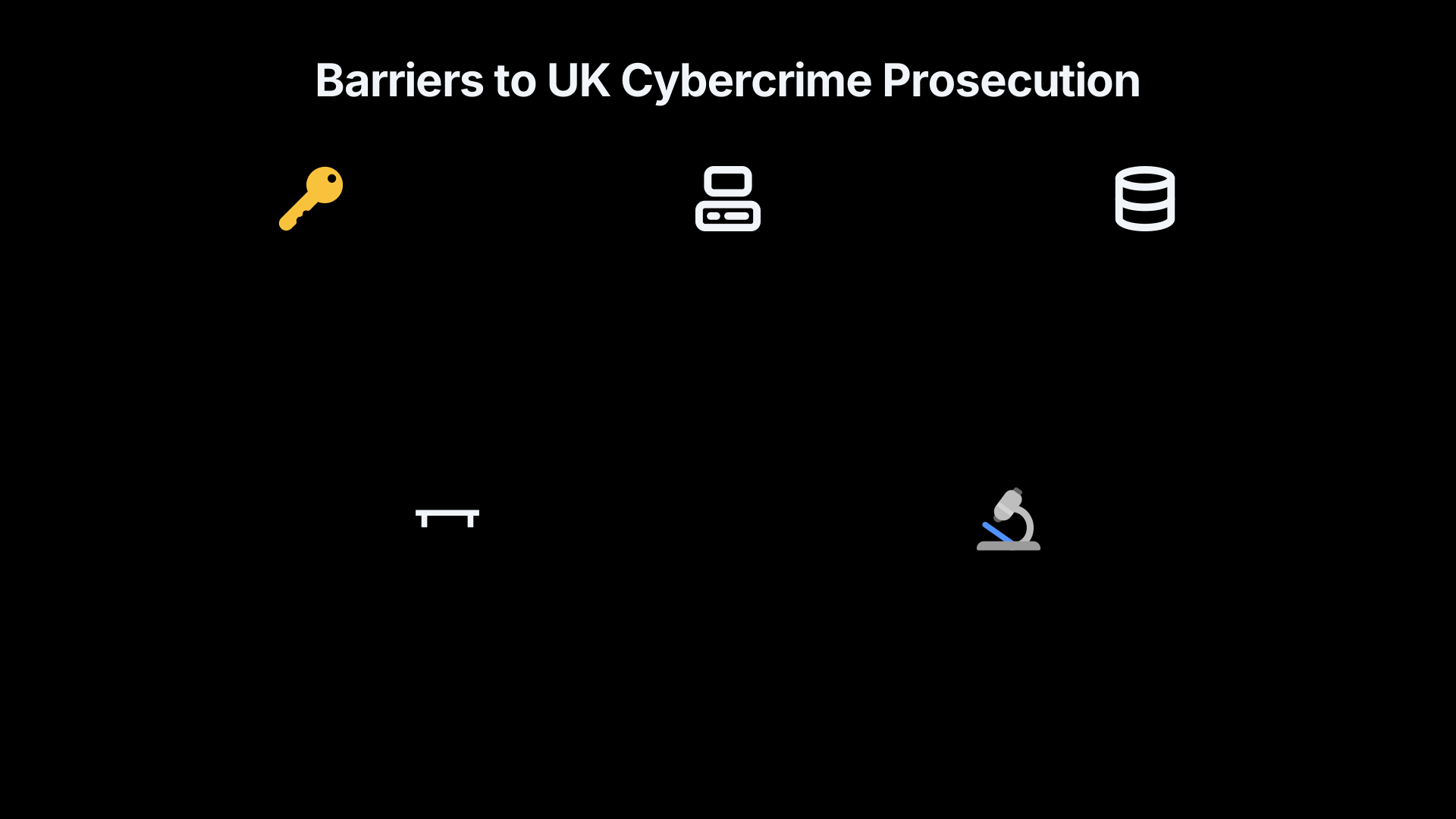
The practical barriers included:
- Witness location: the people needed to explain system compromise, damage, repair costs, sensitivity and operational impact were mainly in the United States.
- Evidence handling: technical evidence from US military and NASA systems would have had to be gathered, disclosed and presented in a form usable in a British criminal court.
- Charge fit: a UK case might have proved some unauthorised access, but not necessarily the broader damage and seriousness alleged by US prosecutors.
- Trial risk: if the strongest evidence related to US systems, US agencies and US harm, a British jury might hear a narrower and less compelling case than the one US prosecutors had prepared.
This is why the CPS decision should be read as a forum-and-evidence judgement, not as a moral verdict on hacking, UFO belief, or US cyber-security. The CPS was not asking whether the story was famous, embarrassing or politically charged. It was asking whether a prosecution in England and Wales was realistically winnable on the evidence available for that court.[Crown Prosecution Service]cps.gov.ukcode crown prosecutors4.6 Prosecutors must be satisfied that there is sufficient evidence to provide a realistic prospect of conviction against…Read more…
Evidence and witness barriers
The US indictment alleged a large intrusion campaign against military and NASA systems, including unauthorised access and damage to computers. Those allegations were rooted in American systems, American victims and American investigative material. That mattered because a British court would not simply accept the headline claim that McKinnon had carried out the “biggest military computer hack of all time”; it would need witnesses and documents capable of proving the relevant elements of the offences charged.[The Guardian]theguardian.comgary mckinnon no uk chargesThe GuardianGary McKinnon will face no charges in UK14 Dec 2012 — No further legal action will be taken in Britain against the computer h…
In cybercrime, “damage” is often not self-explanatory to a jury. Someone has to explain what systems were affected, what access was obtained, what files or services were disrupted, what remediation cost, and why the conduct mattered. In McKinnon’s case, much of that explanation would have depended on US defence and space-agency witnesses. Earlier court reasoning treated that as one reason the United States was the natural forum: the targeted computers, the sensitive information and the claimed consequences were all on the US side of the Atlantic.[Hansard]hansard.parliament.ukHansard Gary Mc Kinnon (ExtraditionHansard Gary Mc Kinnon (Extradition
There was also a difference between proving “he accessed something without permission” and proving a case that captured the full alleged seriousness. McKinnon’s public UFO-related motive may have made him culturally famous, but motive alone would not establish the scale of criminal damage or the reliability of every allegation. A British prosecution that could only prove a reduced version of the case might have been unattractive if the evidential burden, witness burden and likelihood of acquittal remained high.
Why non-prosecution was not exoneration
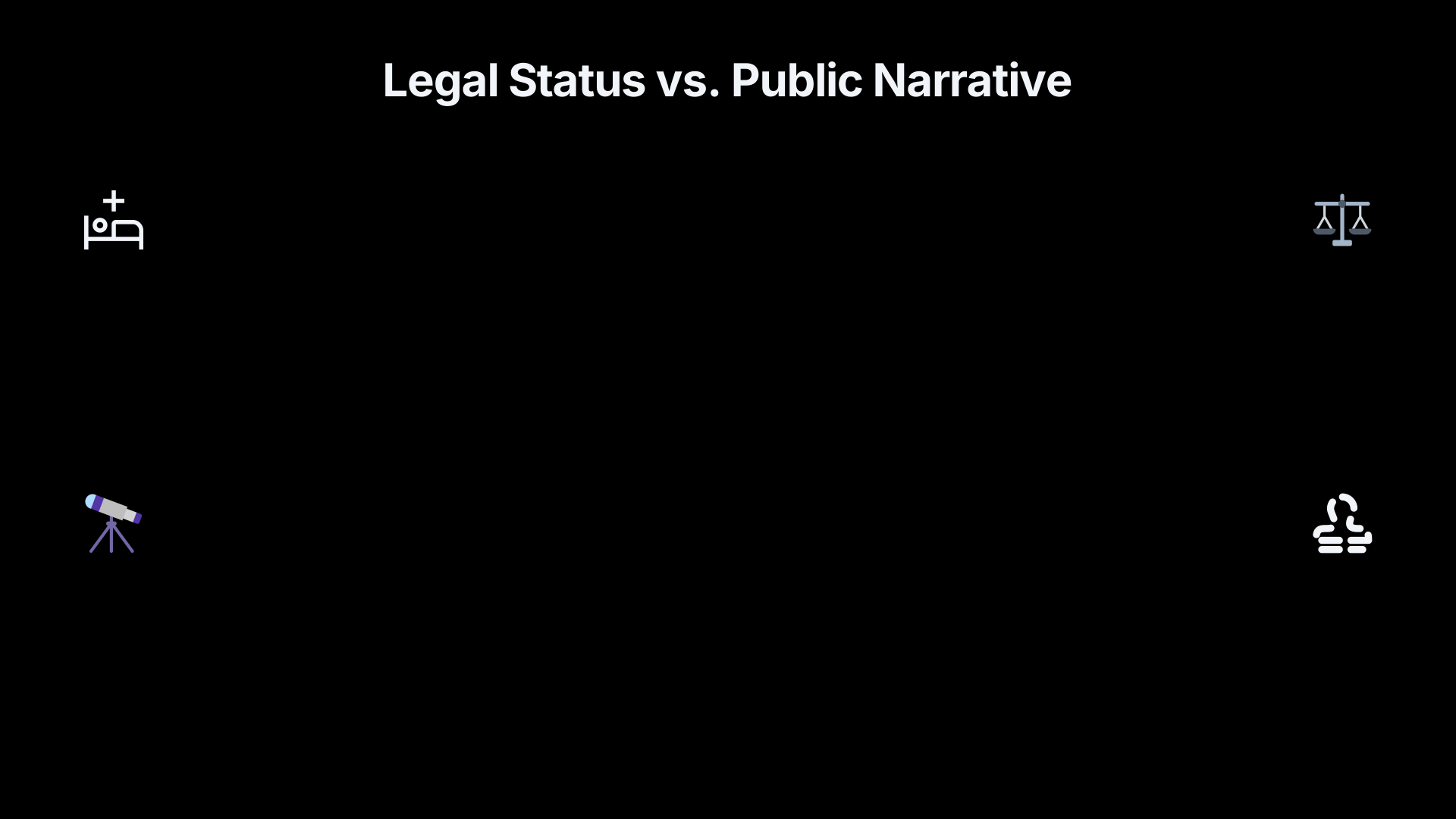
The most important correction is that “not prosecuted in Britain” does not mean “found innocent”. A charging decision is not a trial verdict. It does not test all evidence before a jury, and it does not declare that the alleged conduct did not happen. It means prosecutors decided the case should not go forward under the legal tests they had to apply.
The CPS’s own framework makes that distinction clear. The evidential stage asks whether there is a realistic prospect of conviction on the available, admissible and reliable evidence. A case that fails that test must not proceed, even if the allegation is serious. That is different from saying a suspect has been vindicated.[Crown Prosecution Service]cps.gov.ukcode crown prosecutors4.6 Prosecutors must be satisfied that there is sufficient evidence to provide a realistic prospect of conviction against…Read more…
In McKinnon’s case, the distinction is especially important because three separate ideas are often blurred together:
-
Extradition was blocked because of McKinnon’s health and human-rights risk, not because the US allegations were declared false. GOV.UK
-
A UK prosecution was not pursued because British prosecutors and police judged a domestic case to have poor practical and evidential prospects. The Guardian
-
The UFO claims remained unverified because the non-prosecution decision did not authenticate any alleged NASA images, “non-terrestrial” documents, or other material McKinnon said he saw.
That final point matters for the wider “UFO hacker” narrative. McKinnon’s supporters sometimes treat the end of the legal case as though it closed the factual debate in his favour. It did not. The legal outcome was about extradition risk and prosecutorial viability, not proof of a cover-up.
What the decision shows about governance
The McKinnon case sits at the intersection of cybercrime, extradition, disability, human rights and political pressure. But the no-UK-trial decision was ultimately a governance choice about where a case could fairly and effectively be prosecuted. British authorities had to decide whether, after blocking extradition, they could reconstruct in the UK a case built around US systems, US evidence and US witnesses.
That is why the case became a useful example in later debates about forum. The controversy helped expose a public concern that people accused of crimes with a UK connection could be sent abroad even when much of their conduct occurred at home. A parliamentary committee examining the US-UK extradition treaty noted wider concerns about perceived imbalance and safeguards in extradition arrangements, reflecting the atmosphere in which McKinnon’s case became politically significant. UK Parliament
Yet the CPS decision also shows the limit of a simple “try him here” slogan. A domestic forum may feel fairer to the defendant, but it can be less workable if the strongest evidence, victims, technical records and expert witnesses are abroad. In McKinnon’s case, the British state blocked extradition for exceptional human-rights reasons, then declined to mount a weaker domestic prosecution that prosecutors believed was unlikely to succeed.
The bottom line
Britain did not prosecute Gary McKinnon because the UK case, after extradition was blocked, was judged too fragile: the alleged targets and harm were in the United States, key witnesses and evidence were American, and prosecutors were not confident that a British trial would produce a conviction reflecting the alleged seriousness of the conduct. That was a pragmatic legal decision, not a declaration that McKinnon’s hacking was harmless, and not confirmation of his UFO claims.
Amazon book picks
Further Reading
Books and field guides related to Why McKinnon Was Not Tried in Britain. Use these as the next step if you want deeper reading beyond the article.
The Cuckoo's Egg
Rating: 4.5/5 from 8 Google Books ratings
Explains how international computer intrusions are investigated and prosecuted across borders.
Ghost in the Wires
Provides accessible context on computer intrusion cases, investigations and the public perception of hackers.
Spam Nation
Covers international cybercrime networks and the legal and evidential difficulties faced by authorities.
Kingpin
Rating: 4.5/5 from 6 Google Books ratings
Shows the practical challenges of investigating serious cyber offences and bringing offenders to justice.
eBay marketplace picks
Marketplace Samples
Example marketplace items related to this page. Use the search link to explore similar finds on eBay.




Endnotes
1.
Source: GOV.UK
Link:https://www.gov.uk/government/speeches/gary-[mckinnon-extradition
Source snippet
Gary McKinnon extradition case: Home Secretary's statementOctober 16, 2012 — 16 Oct 2012 — I have therefore withdrawn the extradition ord...
Published: October 16, 2012
2.
Source: GOV.UK
Title: latest on gary mckinnon case
Link:https://www.gov.uk/government/news/latest-on-gary-mckinnon-case
Source snippet
4 Nov 2010 — July 2008 - House of Lords dismisses Mr McKinnon's appeal, ending a series of proceedings under the Extradition Act...
Published: July 2008
3.
Source: cps.gov.uk
Title: code crown prosecutors
Link:https://www.cps.gov.uk/publication/code-crown-prosecutors
Source snippet
4.6 Prosecutors must be satisfied that there is sufficient evidence to provide a realistic prospect of conviction against...Read more...
4.
Source: cps.gov.uk
Link:https://www.cps.gov.uk/principles-we-follow
5.
Source: hansard.parliament.uk
Title: Hansard Gary [Mc Kinnon]({{ ‘mc-kinnon/’ | relative_url }}) (Extradition)
Link:https://hansard.parliament.uk/commons/2009-12-01/debates/09120144000002/GaryMckinnon%28Extradition%29
7.
Source: committees.parliament.uk
Link:https://committees.parliament.uk/writtenevidence/54838/html/
8.
Source: publications.parliament.uk
Title: mckinn 1
Link:https://publications.parliament.uk/pa/ld200708/ldjudgmt/jd080730/mckinn-1.htm
9.
Source: publications.parliament.uk
Link:https://publications.parliament.uk/pa/ld200708/ldjudgmt/jd080730/mckinn-2.htm
10.
Source: committees.parliament.uk
Link:https://committees.parliament.uk/writtenevidence/8245/default/
11.
Source: college.police.uk
Link:https://www.college.police.uk/print/pdf/node/2596
12.
Source: assets.publishing.service.gov.uk
Title: public views 3
Link:https://assets.publishing.service.gov.uk/media/5a7af96ae5274a319e77c120/public-views-3.pdf
14.
Source: thetimes.com
Title: hacker gary mckinnon faces no uk criminal action gjnw293j207
Link:https://www.thetimes.com/world/us-world/article/hacker-gary-mckinnon-faces-no-uk-criminal-action-gjnw293j207
15.
Source: thetimes.com
Title: hacker gary mckinnon faces no uk criminal action gjnw293j207
Link:https://www.thetimes.com/world/us-world/article/hacker-gary-mckinnon-faces-no-uk-criminal-action-gjnw293j207?eafs_enabled=false
16.
Source: legalservicesboard.org.uk
Title: The Code
Link:https://legalservicesboard.org.uk/what_we_do/regulation/pdf/annex13_code_for_crown_prosecutors.pdf
17.
Source: theguardian.com
Title: gary mckinnon theresa may claims
Link:https://www.theguardian.com/world/2012/oct/19/gary-mckinnon-theresa-may-claims
18.
Source: theguardian.com
Title: hacker gary mckinnon supreme court extradition
Link:https://www.theguardian.com/world/2009/oct/09/hacker-gary-mckinnon-supreme-court-extradition
19.
Source: olliers.com
Title: Code for Crown Prosecutors
Link:https://www.olliers.com/news/code-for-crown-prosecutors-the-full-code-test/
20.
Source: Wikipedia
Title: Gary Mc Kinnon
Link:https://en.wikipedia.org/wiki/Gary_McKinnon
21.
Source: newstatesman.com
Title: gary mckinnon
Link:https://www.newstatesman.com/politics/2012/10/gary-mckinnon
Additional References
22.
Source: lexisnexis.com
Link:https://www.lexisnexis.com/en-gb/legal/glossary/code-for-crown-prosecutors
23.
Source: researchgate.net
Link:https://www.researchgate.net/publication/50953384_Hackers_beware_The_cautionary_story_of_Gary_McKinnon
24.
Source: academia.edu
Link:https://www.academia.edu/72391270/Hackers_beware_the_cautionary_story_of_Gary_McKinnon
25.
Source: libertyhumanrights.org.uk
Link:https://www.libertyhumanrights.org.uk/wp-content/uploads/2020/04/Libertys-submission-to-the-JCHR-extradition-inquiry-Jan-2011.pdf
26.
Source: jade.io
Link:https://jade.io/summary/mnc/2008/UKHL/59
27.
Source: vlex.co.uk
Link:https://vlex.co.uk/vid/mckinnon-v-united-states-793612009
28.
Source: iowastatedaily.com
Link:https://iowastatedaily.com/127886/news-world/prosecutors-mckinnon-to-face-no-uk-charges-over-u-s-hacking/
29.
Source: skybrary.aero
Link:https://skybrary.aero/sites/default/files/bookshelf/4776.pdf
30.
Source: emmlegal.com
Link:https://www.emmlegal.com/publications/decision-prosecute-discretion-prosecute-code-crown-prosecutors/
31.
Source: niacro.co.uk
Link:https://www.niacro.co.uk/sites/default/files/publications/The%20Decision%20to%20Prosecute-CPS-2010.pdf
Topic Tree